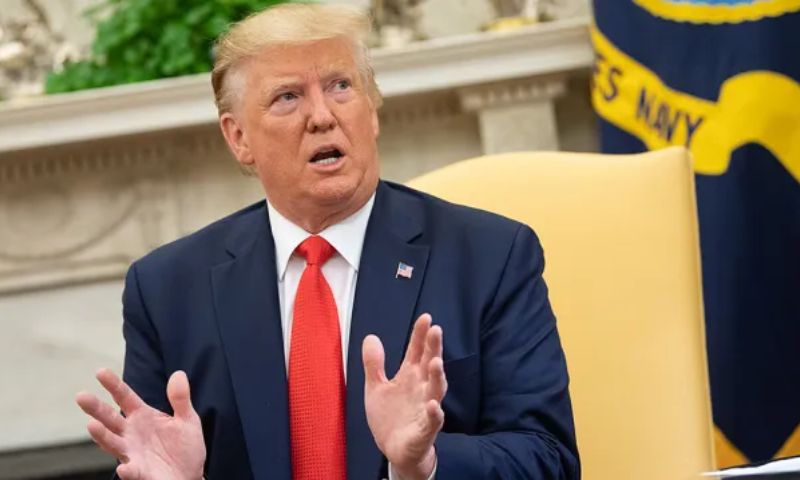
WASHINGTON: US President Donald Trump said on Thursday that he hoped there would be no need for military action against Iran, as tensions continued to rise between Washington and Tehran following threats from Iranian officials to strike American bases and aircraft carriers in the event of an attack.
Speaking to reporters, Trump indicated that diplomatic channels remain open, even as the United States increases its military footprint in the region.
He left open the possibility of avoiding a military operation after earlier remarks warning that time was “running out” for Tehran, as a large US naval fleet moves into Middle Eastern waters, reports AFP.
When asked whether he would be willing to engage in talks with Iran, Trump responded: “I have had and I am planning on it,” signaling a readiness to pursue dialogue alongside pressure.
“We have a group headed out to a place called Iran, and hopefully we won’t have to use it,” the president added while addressing the media at the premiere of a documentary about his wife, Melania Trump.
The remarks come amid heightened rhetoric from Washington and Brussels, coupled with stark warnings from Tehran.
United Nations Secretary-General Antonio Guterres has urged renewed nuclear negotiations, calling for restraint to “avoid a crisis that could have devastating consequences in the region.”
An Iranian military spokesman warned that any US military action would provoke a swift and decisive response. Brigadier General Mohammad Akraminia said Iran’s retaliation would not be limited, as it was in June last year when US planes and missiles briefly joined Israel’s short air war against Iran.
“Our response would be delivered instantly,” Akraminia told state television, adding that US aircraft carriers have “serious vulnerabilities” and that numerous American bases in the Gulf region are within range of Iran’s medium-range missiles.
He cautioned against what he described as US miscalculation, saying any confrontation would not play out as a rapid operation followed by a quick declaration of success. “It will certainly not unfold the way Trump imagines,” he said.
An official from a Gulf state that hosts US military installations told AFP that fears of a US strike on Iran are widespread and growing.
“It would bring the region into chaos,” the official said. “It would hurt the economy not just in the region but in the US and cause oil and gas prices to skyrocket.”
Regional diplomacy has continued alongside the escalating tensions. Qatar’s Emir, Sheikh Tamim bin Hamad Al Thani, held a phone call with Iran’s President Masoud Pezeshkian to discuss efforts aimed at de-escalation and restoring stability, according to the Qatar News Agency.
Meanwhile, the European Union intensified pressure on Tehran by designating Iran’s Islamic Revolutionary Guard Corps (IRGC) as a terrorist organisation, citing its role in a deadly crackdown on recent mass protests.
EU Commission President Ursula von der Leyen welcomed the decision, calling it “overdue” and stating that a regime that “crushes its own people’s protests in blood” deserved such a label. Although largely symbolic, the move prompted a sharp response from Iran.
Iran’s military condemned the EU decision as “illogical, irresponsible and spite-driven,” accusing the bloc of acting in obedience to the United States and Israel, both longstanding adversaries of Tehran.
Iranian officials have blamed recent waves of protests on foreign interference, alleging that US and Israeli agents incited riots and carried out terrorist acts that overtook initially peaceful demonstrations triggered by economic grievances.
On the streets of Tehran, residents expressed a mix of anxiety and resignation. A 29-year-old waitress, speaking anonymously, said she believed war might be unavoidable. “I am not in favour of war,” she said. “I just want something to happen that would result in something better.”
Trump had previously threatened military action if protesters were killed during anti-government demonstrations that erupted in late December and peaked in early January.
More recently, however, his focus has shifted toward Iran’s nuclear programme, which Western powers believe is aimed at developing an atomic weapon.
On Wednesday, the president reiterated that “time is running out” for Tehran to reach an agreement, warning that the US naval strike group that arrived in the region earlier this week was “ready, willing and able” to carry out military operations if necessary.
Iranian authorities have acknowledged that thousands died during the protests, giving a figure of more than 3,000 deaths, while maintaining that most of those killed were members of the security forces or bystanders caught up in violence instigated by what they describe as rioters.
In Tehran, billboards and banners have been erected to reinforce the government’s narrative. One prominent poster in the capital depicts an American aircraft carrier being destroyed, underscoring the tense atmosphere as diplomatic efforts continue alongside preparations for potential conflict.