


KEY POINTS
- Turkiye will offer to mediate between the US and Iran during talks in Ankara.
- Iranian Foreign Minister is scheduled to meet Turkish counterpart on Friday.
- President Trump has threatened military strikes if Iran refuses to negotiate.
- US has increased its military presence in the Middle East, including carrier strike group.
- Iran has warned of swift and powerful response to any attack.
ISTANBUL, Turkiye: Turkiye will offer to mediate between the United States and Iran when Tehran’s top diplomat visits Ankara on Friday, officials said, as tensions escalate after US President Donald Trump’s threats and US military’s growing presence in the Middle East.
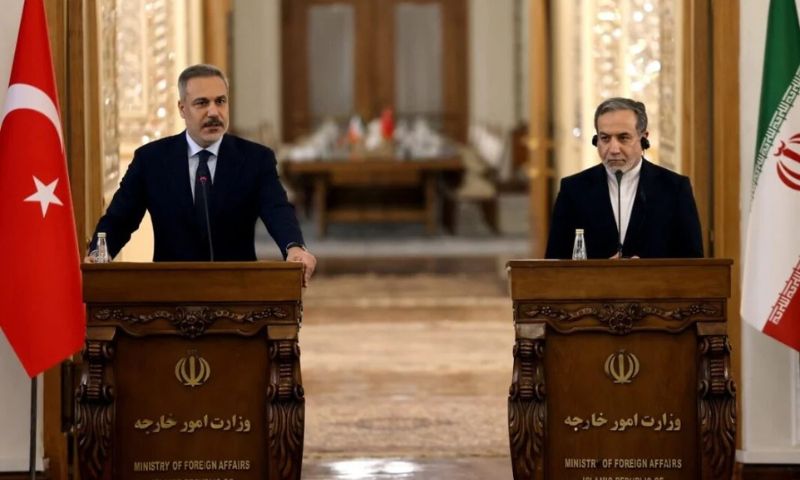
Iranian Foreign Minister Abbas Araghchi is due to hold talks with his Turkish counterpart Hakan Fidan amid mounting warnings from Trump, who has threatened military action if Tehran refuses to negotiate.
Fidan will tell Araghchi that Turkiye “is ready to contribute to resolving the current tensions through dialogue,” a Turkish diplomatic source said, as quoted by AFP.
The source said Fidan would reiterate Ankara’s opposition to “military interventions against Iran” because of the regional and global risks. The source spoke on condition of anonymity due to the sensitivity of the discussions, according to AFP.
Speaking to Al Jazeera television on Wednesday, Fidan said Washington should address its disputes with Tehran step by step, beginning with the nuclear issue rather than bundling all concerns together.
Trump wants nuclear deal
“If Trump invites the Iranians to reach a deal on the nuclear file, they are going to say yes,” said Serhan Afacan, director of the Ankara-based Centre for Iranian Studies (IRAM). “But if you put all of the issues in the same basket, that will be impossible,” he told AFP.
Afacan said Iran’s ballistic missile programme remained a red line because it lies at the core of the country’s defence strategy.
Any compromise, he added, would require lengthy negotiations and credible security guarantees, particularly regarding the United States and Israel.
Turkish media have reported that President Recep Tayyip Erdogan has also pushed Washington for a high-level trilateral meeting involving the US and Iran.
“Turkiye’s focus in US–Iran relations is not necessarily on resolving all disputes, but on preventing a military intervention,” said Ankara-based Iranian academic Arif Keskin.
US military pressure builds
Trump has warned that “time is running out” for Iran to negotiate a nuclear deal, citing a steady build-up of US forces in the Middle East.
He said a “massive armada” was moving towards Iran and was “ready, willing and able” to strike if necessary.
Trump’s repeated threats followed protests in Iran linked to economic hardships and a sharp currency fall.
US officials have confirmed that a naval strike group led by the aircraft carrier USS Abraham Lincoln has arrived in Middle East waters.
Satellite imagery reviewed by BBC Verify also showed fighter jet deployments to the Middle East.
Iran vows retaliation, rejects talks under threat
In response, Araghchi said Iran’s armed forces were ready to respond “immediately and powerfully” to any aggression.
Iran’s army chief, Amir Hatami, said the military was maintaining “strategic advantages for rapid combat” and warned of a “crushing response” to any attack.
Iranian state television reported that 1,000 drones had recently been added to Iran’s combat units.
Senior adviser to Supreme Leader Ayatollah Ali Khamenei, Ali Shamkhani, said any US military action would be considered the “start of war”.
Iran insists its nuclear programme is peaceful and denies seeking nuclear weapons.
Araghchi said Tehran remained open to a “fair and equitable” nuclear deal, but only if talks were free from coercion and threats.
Iran’s deputy foreign minister Kazem Gharibabadi said no negotiations with Washington were currently under way, although messages had been exchanged.