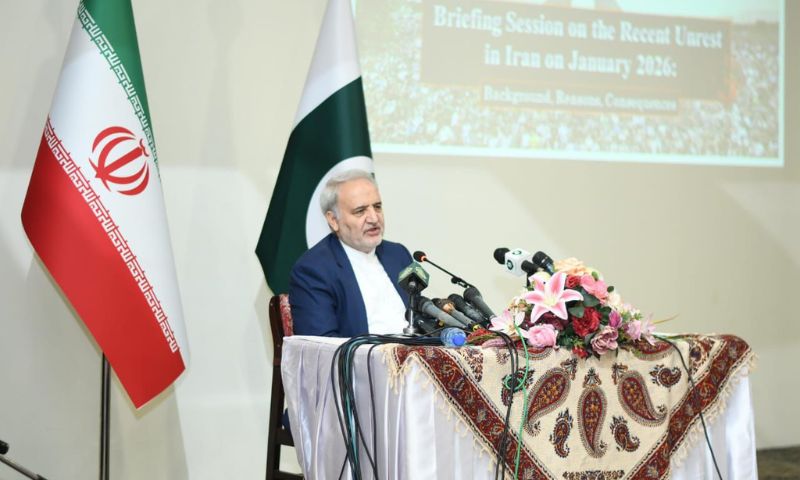
ISLAMABAD: Iran’s Ambassador to Pakistan, Reza Amiri Moghadam, on Thursday said that Tehran “still hopes war can be avoided” and does not seek conflict with the United States, but stressed that the country remains “fully prepared to defend itself if necessary”.
Speaking to the media in Islamabad, the Iranian envoy said, “Iran does not expect or ask Pakistan or any other country to enter a war on its behalf.”
“We do not want war, but we are ready to defend ourselves. We do not demand that any country, including Pakistan, fight for us. We only expect friends to fulfill their responsibilities,” the Iranian envoy said.
Without naming the Israeli prime minister, Ambassador Moghadam clarified that Iran has no ill intentions against any head of state.
‘Shameful’ threats against Supreme Leader
Responding to questions about threats allegedly made by the US President against Iran’s Supreme Leader and counter-statements targeting the Israeli prime minister, Ambassador Moghadam said that targeting or threatening to kill any head of state is a clear violation of international law.
He described threats against Iran’s Supreme Leader Ayatollah Ali Khamenei as “shameful.”
Iran will not bow to American ‘coercion’
The ambassador said Iran would not bow to what he termed American “coercion and intimidation.”
He added that while friends may support Iran in any manner they choose, Iran will not go around seeking military assistance.
Possible refugee influx
On concerns about a possible refugee influx in the event of war, Ambassador Moghadam said no discussions have taken place with Pakistan on this issue so far.
He stressed that Iran is making serious efforts to prevent war, adding that “50 percent of success depends on us and 50 percent on the opposing side.”
He thanked Pakistan for its support and efforts aimed at de-escalation.
Peaceful demonstrations
Commenting on recent protests inside Iran, the ambassador said peaceful demonstrations began due to inflation and fluctuations in foreign exchange rates.
He stated that protesters carried pictures of the Supreme Leader and Iranian national flags, and their demands were acknowledged as legitimate.
According to the Iranian envoy, protest leaders were heard in cabinet meetings, and measures were taken to provide relief to the public.
US and Israeli leadership encouraged sabotage
However, he alleged that after December 31, statements and social media messages by US and Israeli leadership encouraged sabotage, leading to violent actions by armed groups.
He claimed these elements used advanced weapons to attack security forces and police, destroying public and private property.
Providing figures, Ambassador Moghadam said that 3,117 people were killed in the recent unrest.
Of these, he claimed 2,427 were security personnel and ordinary Iranian citizens, while 690 were “militants”.
He further alleged that attackers damaged or destroyed 414 government buildings, 749 police stations, 200 schools, and 350 mosques.
The Iranian envoy also said that those arrested for violence, sabotage, or acting as American or Israeli agents would be dealt with strictly under Iranian law.
Reaffirming Iran’s position on regional cooperation, Ambassador Moghadam renewed his country’s support for defence cooperation between Pakistan and Saudi Arabia and reiterated Iran’s backing for any form of Muslim unity.
Iran–US tensions
On Wednesday, US President Donald Trump urged Iran to negotiate over its nuclear programme or face what he described as “far worse” attacks.
In a series of social media posts, Trump called on Tehran to “come to the table” and agree to a deal that would permanently bar it from acquiring nuclear weapons.
“The next attack will be far worse. Don’t make that happen again,” Trump wrote, saying a powerful US naval force was moving towards Iran.
Meanwhile, US officials confirmed that a strike group led by the aircraft carrier USS Abraham Lincoln had arrived in the Middle East waters as part of an expanded American military presence.
Iran rejects talks under threat
Iranian officials swiftly rejected Trump’s warnings, saying negotiations could not take place under the threat of force and vowing retaliation against any attack.
Ali Shamkhani, an advisor to Supreme Leader Ayatollah Ali Khamenei, said any US military action would result in Iran targeting American interests, Israel, and their supporters.
Foreign Minister Araghchi said Iran’s armed forces were ready to respond “immediately and powerfully” to any aggression.
However, he insisted Iran remained open to a fair nuclear agreement, provided it was reached without coercion and respected Tehran’s right to peaceful nuclear technology.