KEY POINTS
- Trump warns Iran to strike a nuclear deal or face “far worse” US military action.
- US expanded its military presence in Middle East, including naval deployments.
- Iran rejects talks saying negotiations cannot take place under military threats.
- Turkey urges US to resume nuclear talks and avoid war with Iran.
- Iran closes airspace near the Strait of Hormuz for live-fire military drills.
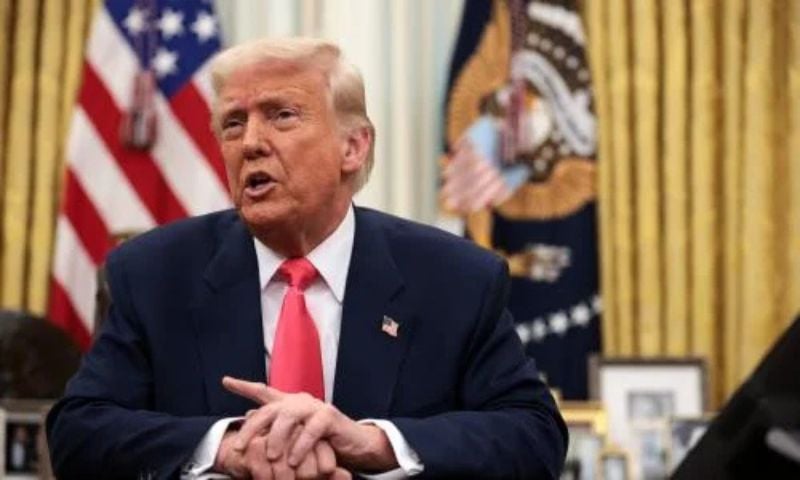
WASHINGTON: US President Donald Trump urged Iran on Wednesday to come to the table and make a deal on nuclear weapons or risk “far worse” military action, as tensions escalated after an expanded US military presence in the Middle East.
“Hopefully Iran will quickly ‘come to the table’ and negotiate a fair and equitable deal – NO NUCLEAR WEAPONS – one that is good for all parties. Time is running out, it is truly of the essence!” Trump wrote in a social media post on his Truth Social platform.
In an apparent reference to the US bombing of three of Iran’s nuclear facilities in June 2025, Trump warned that should Tehran fail to agree a deal, the next attack would be “far worse”.
“The next attack will be far worse! Don’t make that happen again,” Trump wrote. He also warned that another “armada” is floating toward Iran.
“A massive Armada is heading to Iran. It is moving quickly, with great power, enthusiasm, and purpose,” he said in a lengthy post.
Iran rejects talks amid threats
Trump’s outburst came shortly after Iranian Foreign Minister Abbas Araghchi said his country would not restart negotiations amid threats of military action.
Araqchi said he had not been in contact with US special envoy Steve Witkoff in recent days or requesting negotiations, state media reported on Wednesday.
The Iranian Foreign Minister said that there can be no talks with the US amid threats that Washington might consider military action against Tehran.
“Conducting diplomacy through military threat cannot be effective or useful. If they want negotiations to take shape, they must certainly set aside threats, excessive demands, and raising illogical issues,” said Abbas Araghchi after the US deployed an aircraft carrier, Abraham Lincoln, in the Middle East.
“One cannot speak of talks in an atmosphere of threats,” he said in televised comments, adding that in recent days he had “no contact” with US Middle East envoy Steve Witkoff and that “Iran has not sought negotiations”.
ALSO READ: Iran Rejects Talks with US Amid War Threats
Iran’s elite Islamic Revolutionary Guard Corps (IRGC) has meanwhile warned that any new military action against Iran could endanger the flow of global energy supplies through the Strait of Hormuz — a vital shipping route between Iran and the Gulf states.
“We do not want to jeopardise the global economy, but the Americans and their supporters cannot benefit from a war they initiate against Iran,” said Mohammad Akbarzadeh, a political affairs deputy in the Guards’ naval forces, according to state media.
Turkey urges US to start nuclear talks with Iran
Turkey’s top diplomat urged Washington to start nuclear talks with Iran in an interview broadcast Wednesday, as US warships arrived in the region ahead of a possible strike over Tehran’s protest crackdown.
“It’s wrong to attack Iran. It’s wrong to start the war again. Iran is ready to negotiate on the nuclear file again,” Foreign Minister Hakan Fidan told Al-Jazeera television in English.
“My advice has always been to our American friends: close the files one by one with the Iranians. Start with the nuclear issue and close it. Then move on to the others.”
Fidan’s comments after a US naval strike force led by an aircraft carrier took up position in Middle Eastern waters, US Central Command said on Monday, without revealing its precise location.
Washington has not ruled out new military intervention against Tehran over the crackdown against protesters.
Since nationwide protests in Iran earlier this month, Trump has given mixed signals on intervention.
NATO member Turkiye, which shares a 530-kilometre (330-mile) border with Iran, has often expressed opposition to military operations targeting the Islamic Republic.
Last week, President Recep Tayyip Erdogan described the unrest in Iran as a “new test” for Tehran, pledging Turkiye would “stand against any initiative” that would drag the region into chaos.
He said he hoped diplomacy and dialogue would help Iran get through this “trap-filled period”.
Speaking to Al-Jazeera, Fidan said the problems with Iran should be tackled individually.
“Do not treat them as a package. If you put everything together as one package, it will be very difficult for our Iranian friends to digest and truly process it,” he said.
“In some cases, it may even seem humiliating for them. It would be hard to explain not only to themselves but also to their leadership.”
Iran closes airspace for live-fire military drills
Earlier on Wednesday, Iran issued an aviation warning restricting civilian airspace near the Strait of Hormuz as its military prepares to conduct live-fire exercises in the strategically vital waterway.
According to the NOTAM, the Iranian military will conduct live-fire activities as part of scheduled exercises near the narrow waterway.
The drills are set to take place over three days, from January 27 to January 29.
According to Anadolu Agency, the NOTAM specifies that the military activity will occur within a circular area with a radius of five nautical miles.
During the exercises, the designated airspace — extending from ground level up to an altitude of 25,000 feet — will be restricted and considered hazardous for civilian aircraft for the duration of the drills.
Earlier, US Air Forces Central (AFCENT) announced that it would conduct a multi-day readiness exercise across the US Central Command area of responsibility.
The exercise is aimed at demonstrating the US military’s ability to rapidly deploy, disperse and sustain airpower in the region amid rising tensions with Iran.
Washington has reiterated that all options remain on the table in its approach toward Tehran, including military action.
In response, Iranian officials have cautioned that any attack on the country would be met with a decisive reaction.
Tehran has warned that a US strike would trigger a “swift and comprehensive” response, underscoring the risk of a broader regional escalation.