Key Points
• Pakistan aims to boost annual mineral export earnings to $6–8 billion by 2030
• Strategy focuses on processing, refining and value-added production
• Mineral-based industrial clusters tied to export zones are envisioned
• Strategic partnerships, especially with China, are seen as central to transformation
ISLAMABAD: Pakistan is seeking to transform its vast but under-utilised mineral wealth into a major engine of export-led growth, with plans to increase annual mineral export revenues to between $6 billion and $8 billion this decade.
Pakistan plans to achieve this target by moving beyond raw extraction toward value-added production and industrial processing.
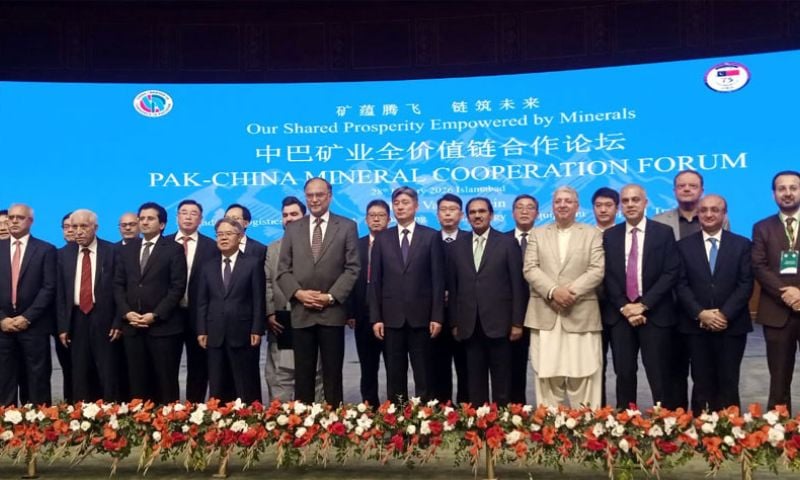
Addressing the Pak-China Mineral Cooperation Forum in Islamabad, Federal Minister for Planning and Development Ahsan Iqbal outlined Islamabad’s intent to develop domestic processing plants, smelters and refining technologies.
These facilities would be linked with Special Economic Zones (SEZs) to build mineral-based industrial clusters, he added.
The approach aims to generate higher export earnings, create jobs, and embed Pakistan more deeply into global mineral supply chains.
Officials told WE News English that today’s Pakistan-China Mineral Cooperation Forum was a buildup to the Pakistan Mineral Investment Forum (PMIF) in April 2026. Pakistan is endowed with significant reserves of copper, gold, coal, marble, granite and other industrial minerals.
Projects such as the Reko Diq copper-and-gold deposit in Balochistan, one of the world’s largest undeveloped copper finds, anchor ambitions for large-scale value addition.
Historically, however, more than 90 per cent of Pakistan’s mineral exports have been raw or semi-processed, a structural constraint that limits export proceeds and upstream industrial development.
Under the new strategy, processing and refining are expected to shift the export mix toward higher-value products that capture more of the global market price.
This shift could reduce reliance on raw commodity sales and broaden the economic impact of mining.
Pakistan’s aggressive minerals marketing is also expected to boost gross domestic product growth, increasing foreign exchange earnings and fostering industrial diversification.
Pakistan’s current mineral exports are relatively modest, around $2 billion annually in raw form, but targeted value addition could multiply this figure several times over.
Strategic international partnerships are central to this vision. Officials at the forum emphasised China’s role, citing its expertise in geological surveying, modern extraction technologies, processing, smelting and environmental management.
Deepening cooperation with China through the second phase of the China-Pakistan Economic Corridor (CPEC 2.0) is seen as a way to translate connectivity into productivity, exports and jobs.
Pakistan is also exploring broader foreign engagement, including potential partnerships with Australia and other major mining investors, to attract long-term capital, technology and know-how into the sector.
With global demand rising for minerals essential to renewable energy, electric vehicles and advanced manufacturing, Pakistan’s policymakers argue that building value-added capacity could position the country as a reliable partner in international supply chains.
Analysts note that while the mineral wealth beneath Pakistan’s terrain is extensive, estimates have put it at several trillion dollars.
However, realising these hidden treasures depends on overcoming challenges such as regulatory bottlenecks, infrastructure gaps, limited geological mapping and skills shortages.
Efforts to modernise the legal framework and introduce transparent investment rules are underway, aimed at attracting the foreign direct investment needed to build processing and refining capacity.
If the government’s strategy succeeds, Pakistan could shift from being primarily a source of raw materials to becoming a competitive supplier of processed mineral products, enhancing its role in regional and global markets and supporting sustainable economic expansion.