KEY POINTS
- US said talks with Netanyahu on Gaza peace plan were “constructive and positive”.
- US envoys urged Israel to reopen the Rafah crossing with Egypt for humanitarian aid.
- Israel wants to restrict the number of Palestinians entering Gaza through Rafah.
- Hamas leaders met Turkish intelligence officials to discuss advancing the Gaza ceasefire.
- Palestinian President Mahmoud Abbas rejected any plan to displace Palestinians.
WASHINGTON: The United States said on Sunday that talks with Israeli Prime Minister Benjamin Netanyahu on the second phase of President Donald Trump’s Gaza peace plan were “constructive and positive”, as diplomatic efforts intensified around the future governance of the Palestinian enclave.
US Special Envoy Steve Witkoff said discussions held on Saturday were positive and focused on next steps.
“The United States and Israel maintain a strong and longstanding relationship built on close coordination and shared priorities,” Witkoff said in a post on X.
“The discussion was constructive and positive, with both sides aligned on next steps and the importance of continued cooperation on all matters critical to the region.”
Yesterday, a U.S. delegation including Special Envoy Steve Witkoff, Jared Kushner, Senior Advisor Aryeh Lightstone, and White House advisor Josh Gruenbaum met with Prime Minister Benjamin Netanyahu. The discussion focused on the continued progress and implementation planning for…
— Special Envoy Steve Witkoff (@SEPeaceMissions) January 25, 2026
Reopening of Rafah crossing
Israeli media reported that Witkoff and US envoy Jared Kushner urged Netanyahu to reopen the Rafah crossing between Gaza and Egypt during meetings in Jerusalem.
The reports followed comments by a newly appointed Gaza administrator last week that the crossing would be operational in both directions next week.
Israeli news website Ynet, citing an unnamed Israeli official, said the meeting was “positive” but that Witkoff pressed Israel to reopen Rafah even before Hamas returns the remains of the last Israeli hostage believed to be held in Gaza.
According to the official, Witkoff also raised the possibility of Turkiye playing a role in Gaza’s future administration.
Israel’s Army Radio later reported that Washington and Netanyahu had reached an understanding on reopening the Rafah crossing.
Israeli website Walla said the crossing could open later this week.
Israel seeks controls at border
Three sources briefed on the matter, cited by Reuters news agency, said Israel wants to restrict the number of Palestinians entering Gaza from Egypt to ensure that more people leave than enter once the crossing reopens.
The sources said the Rafah crossing is expected to be staffed by Palestinians affiliated with the Palestinian Authority and monitored by European Union personnel, as occurred during an earlier ceasefire last year, according to Reuters.
Israel is also seeking to establish a military checkpoint inside Gaza near the border, through which all Palestinians entering or leaving would be required to pass for Israeli security checks, the sources said.
Abbas rejects displacement of Palestinians
Meanwhile, Palestinian President Mahmoud Abbas met Russian President Vladimir Putin in Moscow, reiterating opposition to any attempts to displace Palestinians from their land, according to Palestinian and Russian statements, Al Jazeera reported, citing the Wafa news agency.
Putin reaffirmed Russia’s “principled and consistent approach” to the Palestinian issue, Wafa news agency reported citing the Kremlin.
Egyptian Foreign Minister Badr Abdelatty called for Israel’s withdrawal from Gaza and the reopening of the Rafah crossing during talks in Cairo with US Deputy Secretary of State Christopher Landau, Egypt’s Foreign Ministry said.
Abdelatty stressed the need to implement the second phase of Trump’s Gaza plan, support a national committee to run Gaza and deploy an international stabilisation force to monitor the ceasefire.
Hamas–Turkiye talks in Istanbul
Meanwhile, Hamas leaders led by Khalil Al-Hayya met Turkish intelligence officials, headed by intelligence chief Ibrahim Kalin, in Istanbul to discuss advancing the next phase of the Gaza ceasefire.
According to Hamas, the talks focused on easing humanitarian suffering, opening the Rafah crossing for aid and managing Gaza through a proposed National Committee.
The Hamas delegation thanked Turkish President Recep Tayyip Erdogan for Ankara’s mediation and guarantor role in the ceasefire efforts.
UN criticism of Israel
The UN Special Rapporteur on the occupied Palestinian territory, Francesca Albanese, condemned Israel’s demolition of a compound belonging to the UN Relief and Works Agency for Palestine Refugees (UNRWA) in occupied East Jerusalem.
“I am horrified by the Government of Israel’s relentless destruction, carried out with total impunity,” Albanese said.
She described the action as an unprecedented assault on the United Nations and international law.
She urged the UN General Assembly to convene a special session to consider suspending Israel’s credentials under Article 6 of the UN Charter, and called for sanctions and arms embargoes.
She also appealed to countries to sever ties with Israel without delay.
The demolition of UNRWA's premises is the symbol of what Israel is doing to the UN with full impunity.
I call on:
➡️the Secretary General to request that the General Assembly convene a special session to decide way forward
↗️States to cut ties with Israel without further delay. https://t.co/iMqv0fEBL2— Francesca Albanese, UN Special Rapporteur oPt (@FranceskAlbs) January 24, 2026
‘New Gaza’ plan and humanitarian concerns
The United States last week announced plans for a “New Gaza” rebuilt from scratch, including residential towers, data centres and seaside resorts, as part of Trump’s push to stabilise the ceasefire.
Speaking at the World Economic Forum in Davos, Kushner outlined early ideas for redevelopment.
“In the beginning, we were toying with building a free zone, and then having a Hamas zone,” he said. “And then we said, you know what? Let’s just plan for catastrophic success.”
Trump has linked the Gaza plan to his broader “Board of Peace” initiative, aimed at resolving conflicts globally.
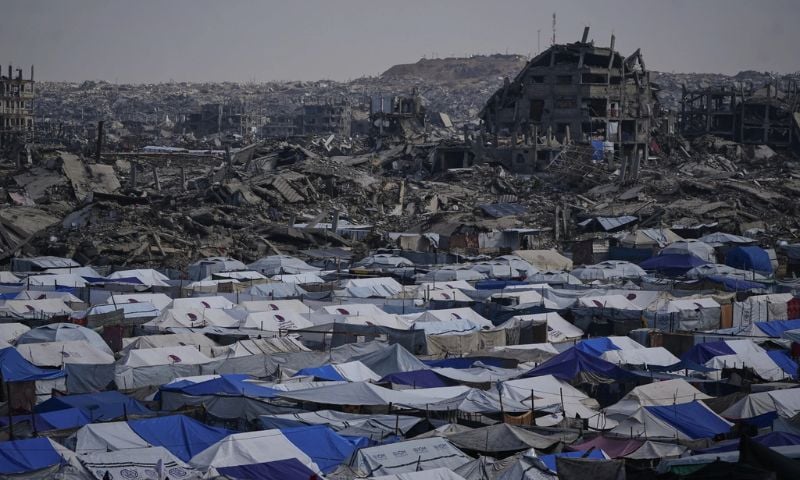
Meanwhile, the United Nations said more than 230,000 women and girls in Gaza, including nearly 15,000 pregnant women, face limited access to reproductive health services despite the ceasefire.
UN spokesman Stephane Dujarric, citing the UN Population Fund (UNFPA), warned of increased risks of gender-based violence, child marriage and exploitation, as damage to health facilities and widespread displacement limit access to care.
Continued violence despite truce
Despite the truce, Israeli violence has continued in Gaza. Gaza health officials said Israeli air strikes killed five people on Thursday.
On Sunday, one Palestinian was killed and four others wounded in Gaza City, medical sources, cited by Anadolu news agency, said.
According to Gaza’s Health Ministry, at least 484 people have been killed and 1,321 injured since the ceasefire took effect.
Palestinian officials accuse Israel of repeated violations.
The war in Gaza, halted by the ceasefire, has killed more than 71,700 Palestinians, mostly women and children, and injured over 171,000 others since October 2023, Gaza health authorities say.