ISLAMABAD: Pakistan’s federal government has taken strong notice of “misleading claims” by the Khyber Pakhtunkhwa provincial government regarding alleged “depopulation” from Tirah Valley of Orakzai district on the orders of the Pakistan Army.
The Ministry of Information and Broadcasting, in a statement, said that these “assertions are baseless, malicious, and driven by ulterior motives aimed at creating alarm among the public, disinformation against security institutions, and furthering vested political interest”.
“No directive has been issued for the depopulation of Tirah by the Federal Government and the Armed Forces. The Law Enforcement Agencies are routinely conducting targeted, intelligence-based operations strictly against terrorist elements, with full care to avoid disruption to peaceful civilian life for which no depopulation or migration is needed or being undertaken,” the Ministry of Information said.
The ministry said that the local population is increasingly concerned about the presence of terrorists and desires peace and stability in the Tirah Valley.
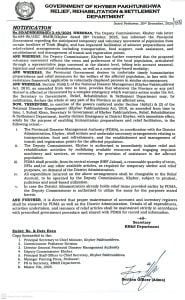
Khyber Pakhtunkhwa Government Relief, Rehabilitation and Resettlement Department has issued a notification for the release of funds on 26 December 2025 (reportedly Rs 4 Billion) for ‘anticipated temporary and voluntary movement of population from certain localities of Tirah (Bagh), and has requested facilitation of advance preparedness and relief-related arrangements including transportation, food support, cash assistance, and establishment and management of transit and registration points.
The document further states that “the Deputy Commissioner, Khyber has further conveyed that the proposed voluntary movement reflects the views and preferences of the local population, articulated through a representative jirga convened at the district level, taking into account seasonal, logistical and contextual considerations, as well as a non-camp-based modality.”
The Ministry of Information said that any stated position of the Provincial Government or their officials being conveyed to the media that the said migration has anything to do with the Armed Forces is false, and fabricated, given with malafide intent to gain political capital and, unfortunately, malign security institutions and therefore highly regrettable.
Political manipulation of Tirah Valley displacement
According to senior security officials, the delayed and badly mismanaged temporary displacement of the local population from the Tirah valley has helped the drug producers and terrorists.
However, the displacement has been misrepresented as a humanitarian crisis by the Khyber Pakhtunkhwa government to blame the military.
Analysts argue that the deliberate delay and administrative decisions by the Khyber Pakhtunkhwa provincial government have contributed to the hardship faced by the local population.
Background: Security concerns in Tirah Valley
Tirah Valley lies in a mountainous region near Pakistan’s border with Afghanistan. Security officials say the terrain allows terrorists to infiltrate easily and blend into the local population.
According to Pakistani security officials, terrorist groups have used Afghan soil as a base to carry out attacks inside Pakistan.
Pakistan’s security forces have killed hundreds of terrorists in intelligence-based operations in recent months.
Eight months ago, the Khyber Pakhtunkhwa provincial government and law-enforcement agencies jointly concluded that the growing presence of terrorists in Tirah valley has held the local population hostage, using civilian cover to carry out nefarious acts of terrorism and coercion of the population, security officials said.
Security officials said local elders were consulted on how to proceed. The local population was requested to either evict the terrorists from amongst them or relocate themselves so that the law enforcement agencies could operate without threat of collateral damage, security officials said.
Decision to temporarily displace civilians
Security officials said that after consultation with local elders, a consensus emerged that a temporary displacement would be necessary to allow targeted operations against terrorists and reduce the risk of civilian casualties.
The agreement, according to officials, was reached publicly in the presence of tribal elders, Khyber Pakhtunkhwa government representatives and Frontier Corps personnel.
Delay and political motives
Security officials said that the Khyber Pakhtunkhwa provincial government deliberately delayed implementation of the displacement plan, which helped the poppy growers and terrorists to reap their crop.
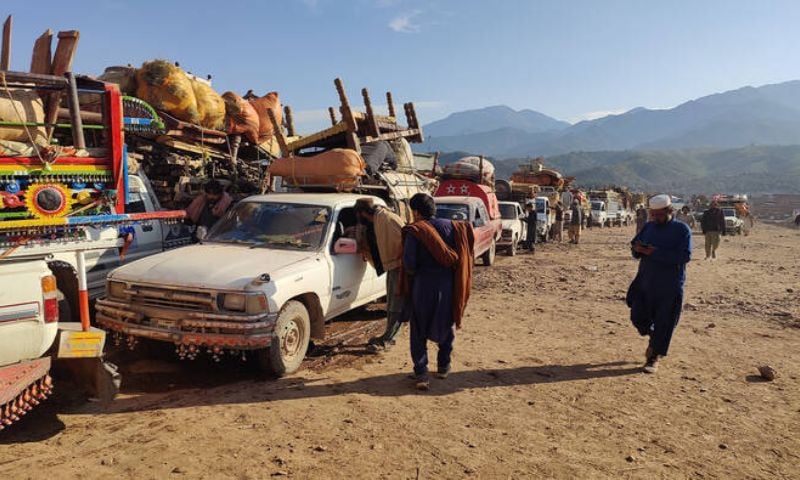
The delay not only gave extra time to terrorists to leave the area but also pushed evacuation into the winter months and generated images of civilian suffering and created a political narrative of victimhood, officials claimed.
Officials further claimed that the delay allowed drug traffickers operating in the area time to harvest narcotics crops and prepare the next planting cycle.
Analysts say the delay was helpful to the narcotics growers and terrorists. They note that evacuation was approved only after the harvest period had ended, which enabled the poppy growers to reap the benefit of their harvest, undermining claims that humanitarian concerns were the primary factor behind the delay.
Administrative failures
On 31 December, the provincial government approved the temporary displacement and allocated Rs 4 billion for the process, according to security officials.
Residents were instructed to leave the area by 15 January, under the supervision of the local administration.
However, analysts say the Khyber Pakhtunkhwa provincial administration deployed very few registration counters and limited staff at exit points. They say this caused long queues, confusion and delays.
Officials claim these administrative bottlenecks were avoidable and were later highlighted by the provincial government to generate distressing visuals and amplify political messaging.
Responsibility for displaced persons
Security officials stressed that the management of displaced civilians falls entirely under the provincial government’s mandate.
They said registration, shelter, food, healthcare, compensation and logistics are civilian administrative responsibilities, not military ones.
The military, they said, had no role at registration points. They said the Khyber Pakhtunkhwa government portrayed provincial mismanagement as military shortcomings.
Corruption and financial misuse
Analysts allege that senior provincial government officials, including Chief Minister Sohail Afridi and his team, benefited from the Rs 4 billion allocation.
They claim the chaos surrounding displacement reflects corruption rather than institutional collapse.
Analysts say depopulation was sought to minimise civilian harm and allow precise, intelligence-based operations.
They argue that had civilians remained in the area, the same political actors might have accused the military of risking civilian lives.
Temporary displacement during counter-terrorism operations is a recognised practice globally, analysts said. They rejected claims that the move amounted to collective punishment.
Future risks
Analysts warned that with new narcotics crops now planted, similar misleading claims could emerge during the return phase just for political gains.
They said any delay in repatriation, regardless of security conditions, could be used to trigger unrest and apply political pressure through baseless propaganda.
Governance or humanitarian crisis?
Security officials said the Tirah episode reflects governance and administrative failure in Khyber Pakhtunkhwa rather than a humanitarian collapse.
They accused political actors, including the Pakistan Tehreek-e-Insaf (PTI), which governs the province, of reframing administrative failure as a humanitarian emergency.
Officials said civilian suffering was being politicised to deflect responsibility from provincial government.