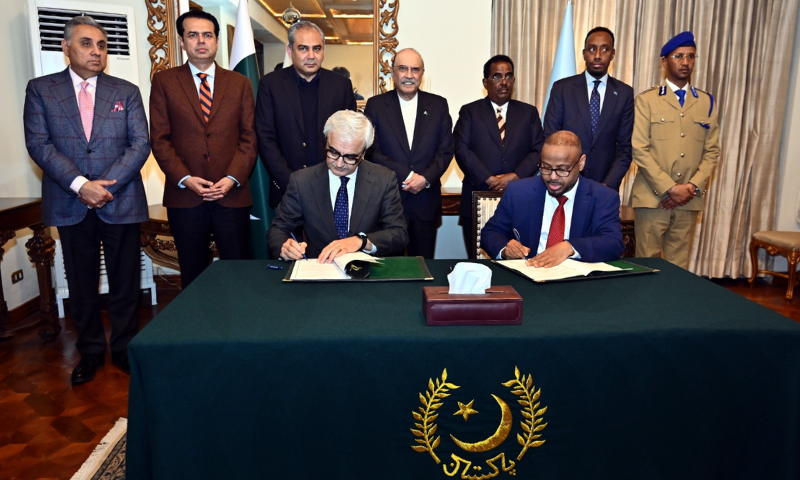
ISLAMABAD, Jan 24, 2026: Pakistan and Somalia have signed an agreement abolishing visa requirements for holders of diplomatic passports, as the two sides moved to revitalise bilateral ties and expand cooperation on security and governance.
According to a statement from Pakistan’s President’s Office, the agreement was signed in Islamabad during a meeting between Pakistan’s President Asif Ali Zardari and Somalia’s Minister of Interior Ali Yousuf. The signing was witnessed by the president as both delegations discussed avenues for closer engagement.
The accord was inked by Hamza Adan Haadoow, Permanent Secretary at Somalia’s Ministry of Foreign Affairs and International Cooperation, and Dawood Muhammad Baraech, Special Secretary at Pakistan’s Ministry of Interior and Narcotics Control.
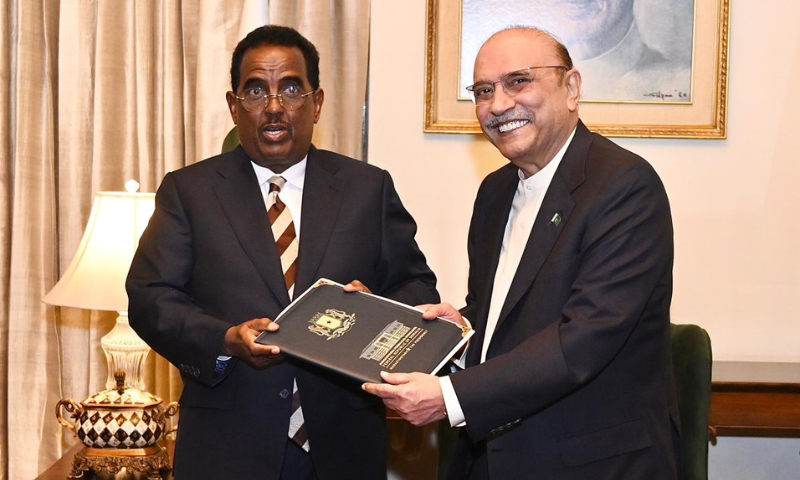
President Zardari underscored Africa’s growing importance in the global geopolitical landscape and said Pakistan seeks to strengthen ties with African states, including Somalia. He reaffirmed Islamabad’s commitment to expanding cooperation with Mogadishu in areas of shared interest.
Officials said the visit by Somalia’s interior minister marked the first bilateral official visit from Somalia to Pakistan in 35 years, signalling a reset in relations.
The president also reiterated Pakistan’s commitment to regional and international efforts against transnational crime and narcotics trafficking, while broader geopolitical developments and opportunities for bilateral cooperation were discussed.
Minister Ali Yousuf thanked the government of Pakistan, particularly the Ministry of Interior, for what he described as warm hospitality. He said he was visiting at the invitation of Pakistan’s interior minister and conveyed greetings and goodwill from Somalia’s leadership and people.
The Somali minister also delivered a letter from Somalia’s president to President Zardari, reaffirming Mogadishu’s desire to deepen bilateral ties. He described Pakistan as a reliable partner since Somalia’s independence and recalled the sacrifices of Pakistani peacekeepers who served under the United Nations flag in Somalia during the 1990s.
During the talks, both sides exchanged views on enhancing cooperation in law enforcement and criminal justice. Discussions covered the feasibility of negotiating a bilateral extradition treaty, legal frameworks governing extradition in both countries, and the possibility of initiating talks on mutual legal assistance in criminal matters and the transfer of sentenced persons.
Counter-narcotics cooperation also featured prominently, with the two sides exploring collaboration against drug trafficking and organised crime, as well as information and intelligence sharing, capacity building and personnel training.
Pakistani officials said Islamabad had offered assistance through the National Database and Registration Authority in advanced identity management, civil registration and secure documentation systems, along with training support for Somalia’s police force.