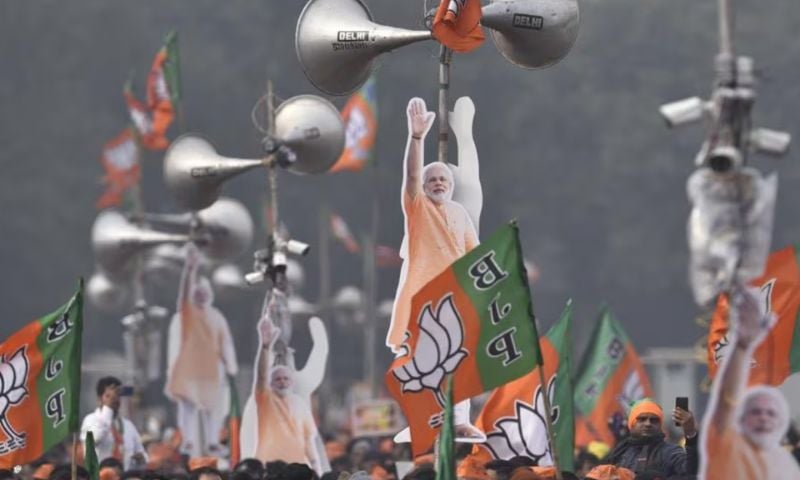
ISLAMABAD: Hate speech incidents targeting religious minorities in India surged sharply in 2025, with most incidents occurring in states governed by the ruling Bharatiya Janata Party (BJP), according to a report by the India Hate Lab (IHL), a research initiative of the Washington-based Center for the Study of Organized Hate.
The 100-page report, released on January 13, 2026, documented 1,318 verified in-person hate speech events across India during 2025. That marked a 13% increase from 2024 and a 97% rise since 2023, according to the report.
The hate speech incidents were recorded across 21 Indian states, Indian Illegally Occupied Jammu and Kashmir (IIOJK), and the National Capital Territory of Delhi, averaging four hate speech incidents a day, according to the report.
Muslims and Christians main targets
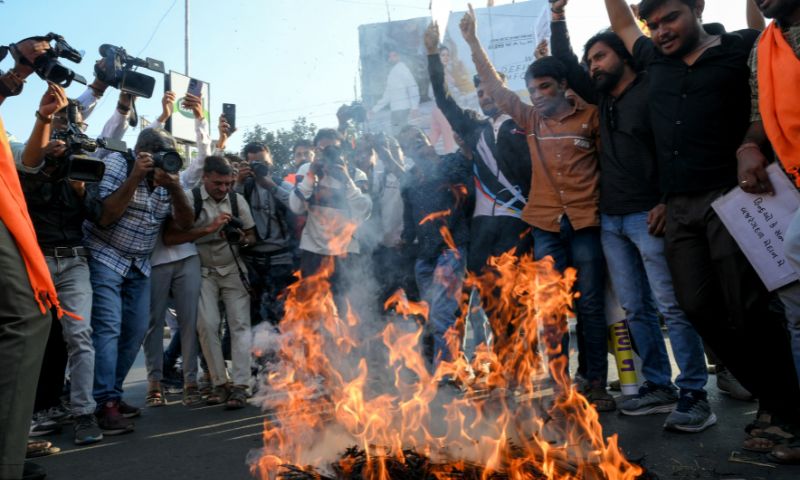
Religious minorities were the main targets of the hate speech in India, the report said.
Muslims were targeted in 1,289 incidents, accounting for 98% of all recorded events. Of these, 1,156 speeches targeted Muslims alone, while 133 targeted Muslims and Christians together.
Christians were targeted in 162 incidents, a 41% increase from 2024. The report identified 29 explicitly anti-Christian events, with the remainder overlapping with anti-Muslim rhetoric.
The researchers also documented 69 incidents targeting Rohingya refugees and 192 speeches referring to “Bangladeshi infiltrators”, a recurring trope in political discourse.
Minorities were frequently described using dehumanising language, including terms such as “termites,” “parasites,” “insects,” “pigs,” “mad dogs,” “green snakes,” and “bloodthirsty zombies,” the report said.
Violence and ‘dangerous speech’

The report classified 308 incidents as “dangerous speech”, defined as rhetoric that explicitly or implicitly incites violence. Nearly all of these targeted Muslims and Christians.
The report identified 656 speeches promoting conspiracy theories, including narratives such as “love jihad,” “land jihad,” “population jihad,” “vote jihad,” “education jihad,” and “spit jihad.”
Explicit calls for violence against religious minorities were recorded in 308 events, including 136 direct calls to arms violence.
Economic and social boycotts were urged in 120 speeches against religious minorities, often calling on Hindus to avoid Muslim traders or halal products.
Hindu speakers encouraged the destruction of religious sites of minorities in 276 events, repeatedly naming the Gyanvapi Mosque in Varanasi and the Shahi Idgah Mosque in Mathura, according to the report.
Political links and election timing
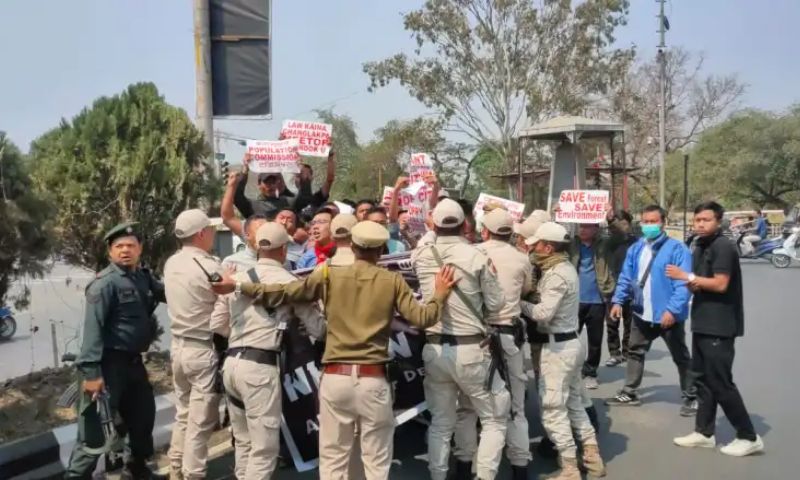
The report findings highlight a strong correlation between political control and the frequency of hate speech incidents against minorities in India.
The report said that 88% of all hate speech incidents — 1,164 events — occurred in BJP-governed states, a 25% rise from 2024.
Opposition-ruled states recorded 154 incidents of hate speech against minorities, a 34% decline, the report said.
The highest concentrations were recorded in Uttar Pradesh, Maharashtra, Madhya Pradesh, Uttarakhand, Rajasthan, Delhi, Bihar, Gujarat, Haryana, Karnataka, Assam and Chhattisgarh.
Spikes in hate speech incidents in India coincided with election periods.
The report recorded 24 incidents during Uttarakhand municipal elections, 27 ahead of Delhi assembly elections, and 42 during Bihar assembly polls in October–November.
A sharp rise was also recorded in April 2025, linked partly to Ram Navami processions and politicised responses to the Pahalgam incident, the report said.
Organisations and speakers fuelling hate speech
More than 160 organisations were linked to fuelling hate speech events, most aligned with the RSS–BJP ideological network, according to the report.
Groups named included the Vishwa Hindu Parishad (VHP) and Bajrang Dal, linked to 289 events, and the Antarrashtriya Hindu Parishad and Rashtriya Bajrang Dal, linked to 138 events.
Other groups cited included Sakal Hindu Samaj, Hindu Raksha Dal, Hindu Jagran Manch, Shri Ram Sena, Hindu Yuva Vahini and Hindu Rashtra Sena.
Hindu nationalist figures were responsible for 145 events, a 27% increase from 2024, the report said.
Senior politicians and activists, including Pushkar Singh Dhami, Pravin Togadia, Ashwini Upadhyay, Nitesh Rane, T. Raja Singh, Amit Shah, Yogi Adityanath, and Yati Narsinghanand Saraswati, among others were found involved in fuelling hate speech and inciting violence against minorities.
From rhetoric to violence
The report linked hate speech directly to real-world harm. It said more than 1,500 Bengali-origin Muslims were expelled in Assam and neighbouring regions in May and June 2025 following hate campaigns.
It cited lynching cases, including the killings of Ram Narayan on December 17, 2025, and Jewel Sheikh on December 24, 2025.
Researchers documented mosque demolitions, church disruptions, forced evictions, and the demolition of entire Muslim neighbourhoods, particularly in Assam and Gujarat.
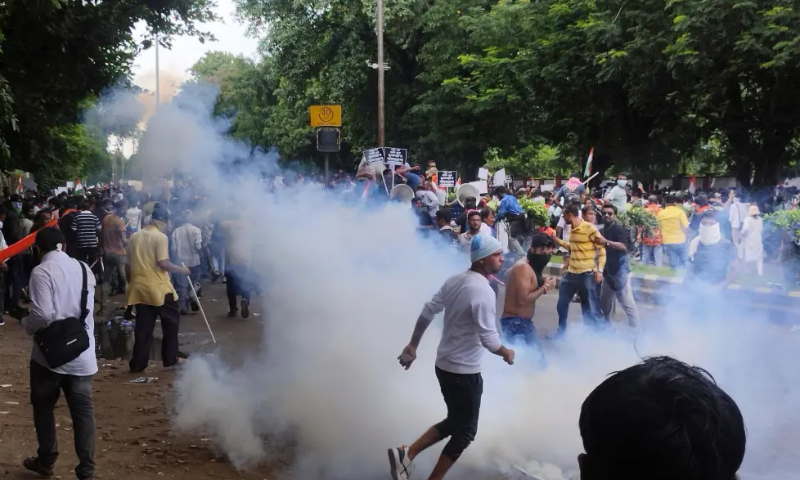
The report said violent incidents often occurred days or hours after hate speeches, emboldening mobs and vigilante groups.
Role of social media
Nearly 97% of all hate incidents were recorded or live-streamed, the report said.
Of these, 942 videos were first uploaded on Facebook, with further amplification on YouTube, Instagram and X.
Researchers said platforms repeatedly failed to enforce their own policies.
They noted the growing use of AI-generated posters, deepfake videos and stylised content to evade moderation.
The report recommended that violent Hindu nationalist groups be classified as Tier-1 Dangerous Organisations under Meta’s policies.
Institutional failures and international warnings
The report said police rarely intervened or acted on complaints related to hate speech.
Courts, including the Supreme Court, did not proactively monitor incidents, it said.
India lacks a national hate speech law. Only Karnataka enacted specific legislation in 2025, introducing prison terms of one to seven years, though the report said its impact remains limited.
The resulting impunity has allowed hate speech to enter mainstream political communication, the report said.
Several international organisations voiced strong concerns over the alarming surge in hate speech and violence against minorities in India.
The US Holocaust Memorial Museum’s Early Warning Project, released in late December 2025, ranked India fourth globally for the risk of a new mass killing, estimating a 7.5% probability of large-scale violence before the end of 2026.
The South Asia Justice Campaign, in its January 2026 tracker, documented at least 50 extrajudicial killings of Muslims in 2025, attributing them to state forces and extremist groups.
Genocide Watch continues to list India at Stage 8 (Persecution) of its genocide risk framework. Its founder, Gregory Stanton, has warned that mass violence “could very well happen in India”.
The Indian American Muslim Council, in a January 2026 report, cited ongoing mosque demolitions, lynchings and forced evictions as evidence of systematic targeting of minorities.
The India Hate Lab warned that hate-driven mobilisation could intensify ahead of elections scheduled between 2026 and 2029, unless legal, institutional and social media reforms are introduced.
The failure to curb hate speech threatens minority safety, democratic norms and regional stability.
“Hate speech has become a structural tool of politics,” an analyst said, warning that without accountability, the risks of wider violence will continue to rise.