Key Points
• World Economic Forum 2026 begins Monday in Davos, Switzerland
• Over 60 heads of state, 55 finance ministers and 800 corporate leaders expected
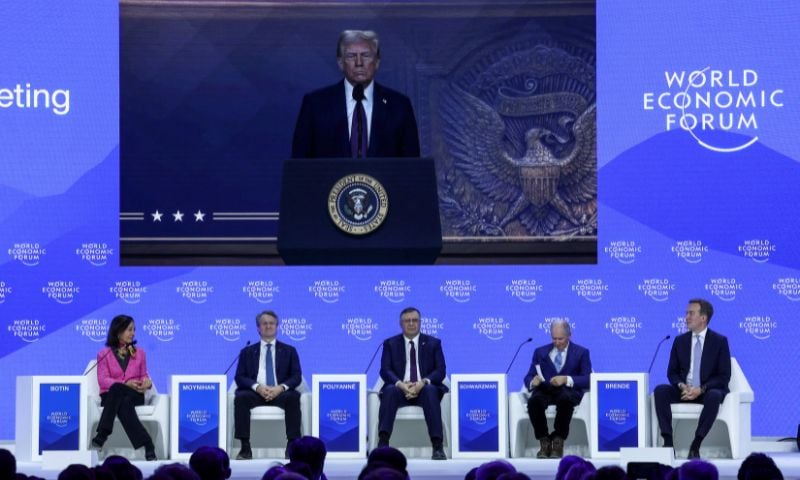
• The United States sends its largest delegation, led by President Donald Trump
• Key topics: war in Ukraine, trade disputes, AI, climate change, and global cooperation
ISLAMABAD: World leaders, business executives, and international institutions gather this week in Davos, Switzerland, as global tensions rise and trust between nations is under strain.
The 2026 (19–23 January) World Economic Forum, opening Monday in the Swiss Alps, brings together political and corporate leaders to address urgent global challenges. The annual meeting, themed “A Spirit of Dialogue,” takes place amid ongoing wars, trade disputes, and rising competition between major powers. The United States’ aggressive policies against Venezuela and Iran have already upped the ante over global debates and discussions.
President Donald Trump will lead the largest-ever US delegation, including senior officials from foreign policy, trade, and finance. Analysts say Washington’s recent tariffs, military actions, and hardline policies have already shaken up global economic and security dynamics, making the forum a critical stage for response from other nations.
Trump’s recent actions and overtures, from the cross-border abduction of the former Venezuelan president to the tariff threat to Europe over Greenland, are likely to heat discussions at the World Economic Forum. Russia, China, and Iran are likely to present the alternative worldview. Russian President Vladimir Putin has recently stated that the policy of “might is right” cannot bring peace to the world; it needs patience and time-consuming efforts to achieve peace.
Ukrainian President Volodymyr Zelensky is also attending to secure continued support for Kyiv in the event of war with Russia.
European leaders, including top officials from the European Union and NATO, plan to push for stronger coordination on defence, energy security, and trade policy. Davos Forum offers them a platform to signal commitments to Ukraine and counterbalance rising global risks.
A recent World Economic Forum survey of over 1,300 politicians, business leaders, and academics identified “geoeconomic confrontation,” competition between major powers using trade, finance, and technology, as the most pressing risk over the next two years.
The second greatest concern is direct armed conflict.
These concerns frame the discussions in Davos, where military spending, economic uncertainty, and diplomatic tensions dominate the agenda.
Global military expenditure has risen to $2.7 trillion, marking the largest increase since the end of the Cold War. Countries worldwide are investing in defence to respond to perceived threats from the overwhelming world powers and rivals. Leaders attending Davos will debate how the rising military budgets affect global stability, economic growth, and diplomatic relations.
Technology and climate issues also feature prominently.
Artificial intelligence, largely driven by US companies, continues to reshape markets and labour dynamics. The UN will launch an independent scientific panel to review AI developments during the forum. Climate change remains a priority, even as environmental groups highlight the carbon footprint of Davos, including a surge in private jet travel.
The forum draws over 800 corporate executives, 55 finance ministers, and more than 60 heads of state.
Beyond formal sessions, Davos hosts thousands of private meetings where deals are struck, alliances tested, and policy directions influenced.
This year marks the first Davos without founder Klaus Schwab, who stepped down last year after more than 50 years of leading it. Despite leadership changes and criticism, attendance remains high, showing Davos’s continued influence in shaping global agendas.
While major agreements may not emerge immediately, the forum allows nations, corporations, and international organisations to signal priorities, coordinate strategies, and manage crises.
With wars ongoing, rising trade tensions, and eroding trust, the 2026 Davos meeting is widely seen as a test of whether dialogue can still prevent further breakdowns in the global order.