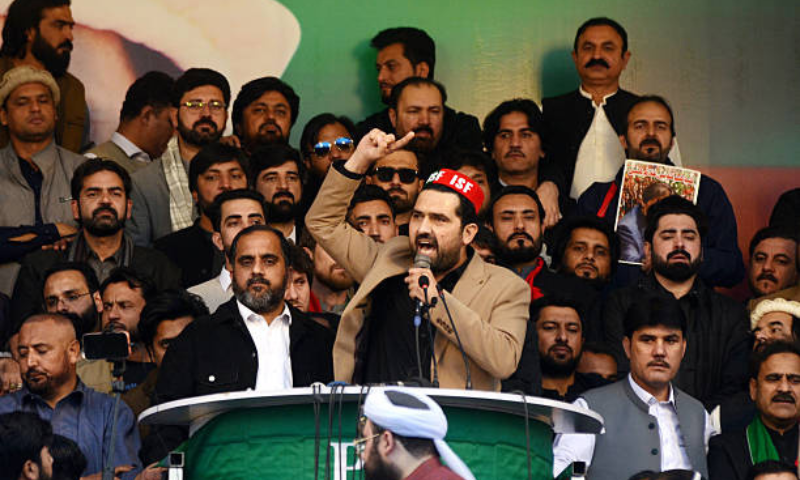



ISLAMABAD: Why is KP Chief Minister Sohail Afridi blocking kinetic operations against the Tehrik-i-Taliban Pakistan (TTP) and other militant groups, even as attacks on security forces surge?
Is political loyalty to former Prime Minister Imran Khan driving a dangerous tolerance for armed networks in border regions? Analysts and federal officials warn that Afridi’s insistence on negotiation over action, coupled with questioning evidence of Afghan-based militancy, effectively shields terrorist networks, allowing narcotics and foreign-funded insurgencies to expand in strategic erstwhile tribal districts bordering Afghanistan— putting both provincial and national security at risk.
Analysts say Afridi’s stance is rooted in political loyalty to Khan and a long-standing PTI approach that prioritizes negotiation with armed groups. Critics argue that this has created the perception of provincial tolerance for militancy, particularly in strategic border areas such as Tirah Valley and Kurram district, where the Tehrik-i-Taliban Pakistan (TTP), Islamic State Khorasan Province (ISKP), and the Hafiz Gul Bahadur (HGB) faction maintain strong footholds.
Security officials warn that poppy cultivation and narcotics trafficking have established a parallel economy financing terrorist operations, with roughly Rs. 30 billion reportedly flowing to TTP networks in recent years.
According to official data, around 12,000 acres in Tirah are under poppy cultivation, producing profits between Rs. 1.8 million and Rs. 3.2 million per acre. The sheer scale of this illicit trade makes it one of the most lucrative sources of militant financing in the region.
Lt Gen Ahmed Sharif Chaudhry, Pakistan’s military spokesperson, recently stated that “the TTP is not a separate entity — it is a branch of the Afghan Taliban.” This relationship, analysts say, extends far beyond ideology.
According to Pakistani officials, the TTP collects a 10 percent Ushar — an Islamic tithe on agricultural income — from poppy farmers in Tirah.
If each acre generates roughly Rs. 2.5 million, the valley’s 12,000 acres yield around Rs. 30 billion annually. Ten percent of that — nearly Rs. 3 billion — goes directly to the TTP.
In return, the group offers “security” to smugglers, drug traders, and cultivators, ensuring their operations continue unimpeded.
“This is the bargain between the TTP, the smugglers, and the poppy growers,” one senior security official said. “It is a criminal economy disguised as resistance.” After Afghanistan banned poppy cultivation in 2023, production shifted to Pakistan’s KP and Balochistan, bringing Afghan expertise and networks across the border. This move has reinforced the TTP–Afghan Taliban financial ecosystem, linking sanctuary, logistics, and trafficking profits.
The PTI’s political approach has drawn sharp criticism from federal officials, the KP governor, and most mainstream political parties across Pakistan. Governor Faisal Karim Kundi accused Afridi of effectively representing Afghan interests over provincial security and urged the PTI government to end its obstruction of military action against terrorists.
Director General Inter-Services Public Relations (ISPR) Lt Gen Ahmed Sharif Chaudhry also criticized the PTI for allegedly providing political cover to militants and spreading an “anti-army” rhetoric, stating that such narratives were now out of the realm of politics and had become a “national security threat”.
Lt Gen Ahmed Sharif Chaudhry said the anti-army narrative pushed by Imran Khan has shifted from politics to a national security threat, operating in collusion with external actors.
National political figures joined the chorus. PML-N’s Planning Minister Ahsan Iqbal described Khan’s rhetoric as “deeply irresponsible and dangerous,” warning it weakened national cohesion.
ANP. MQM-P and PPP leaders echoed these concerns, accusing the PTI of destabilizing the country, spreading propaganda aligned with hostile foreign agendas, and undermining Pakistan’s security institutions.
Awami National Party leader Mian Iftikhar Hussain has recently accused the ruling Pakistan Tehreek-i-Insaf of neglecting counterterrorism efforts and prioritising protests for the release of party founder Imran Khan, warning that militancy is worsening as the government fails to focus on security challenges.
PML-N leader and Planning Minister Ahsan Iqbal called Imran’s political rhetoric “a deeply irresponsible and dangerous trend that seeks to undermine Pakistan’s state institutions, weaken national cohesion, and erode public trust in the armed forces who defend our borders with courage and sacrifice.”
Railways Minister Hanif Abbasi specifically linked alleged PTI fundraising from foreign sources to security threats and warned that previous government inaction had emboldened terrorism.
The security situation in KP remains dire. Most of the attacks targeted security forces, with TTP strongholds in North and South Waziristan expanding into Lakki Marwat district. ISKP continued assaults on civilians, including communities, tribal leaders, and politicians.
Hafiz Gul Bahadur’s faction further complicated operations along the Afghan border, highlighting the porousness of the frontier and the convergence of political instability, tribal disputes, and militant activity.
Lt Gen Ahmed Sharif Chaudhry, spokesperson for pakistan military said, Pakistan’s security forces carried out more than 75,000 intelligence-based operations in 2025, killing 2,597 militants but losing 1,235 civilians and law enforcement personnel, with Khyber Pakhtunkhwa bearing the brunt of violence amid 5,397 terror incidents and 27 suicide bombings, most of them in KP and Balochistan.
Analysts warn that Afridi’s approach intended to avoid conflict for shortterm political gains, risks enabling cross-border networks tied to the Afghan Taliban and Islamic State. The result is a volatile security environment with potential regional ramifications, particularly as Pakistan balances counterterrorism needs with domestic political pressures on Afghanistan.
While PTI leaders defend Afridi’s position as principled negotiation, security experts caution that the strategy leaves KP vulnerable to militant expansion, fuels sectarian violence, and undermines coordinated federal operations.
With terrorist attacks escalating and federal-provincial tensions deepening, the province faces a critical crossroads between political expidency and the urgent demands of national security.