ISLAMABAD: Regional Arab and Muslim countries on Thursday stressed the need to consolidate the Gaza ceasefire, halt any violations, and ensure the unhindered entry of humanitarian aid into the besieged Palestinian territory, according to a joint statement.
The foreign ministers of Pakistan, Egypt, Jordan, the United Arab Emirates, Indonesia, Turkiye, Saudi Arabia and Qatar welcomed the formation of a Palestinian Technocratic Committee, the national committee for the administration of the Gaza Strip, to temporarily run affairs in Gaza in coordination with the Palestinian Authority under the UN-backed peace framework, according to joint statement issued by Pakistan’s Foreign Ministry.
Pakistan, Egypt, Jordan, the United Arab Emirates, Indonesia, Turkiye, Saudi Arabia and Qatar are acting as mediators for the Gaza Peace Plan.
The National Committee for the Administration of the Gaza Strip (NCAG) is a temporary transitional body established pursuant to UN Security Council Resolution 2803, within the framework of the second phase of the Comprehensive Peace Plan and in coordination with the Palestinian Authority.
The Arab and Muslim countries’ foreign ministers emphasised the importance of the National Committee commencing its duties in managing the day-to-day affairs of the people of Gaza, while preserving the institutional and territorial link between the West Bank and the Gaza Strip, ensuring the unity of Gaza, and rejecting any attempts to divide it, the joint statement read.
The foreign ministers expressed their full support for the announcement of the commencement of the second phase of US President Trump’s peace plan.
They expressed their appreciation for the leadership and efforts exerted by President Trump and his commitment to ending the war in the Gaza Strip, ensuring the withdrawal of the Israeli army, preventing the annexation of the occupied West Bank, and advancing peace in the region.
The foreign ministers stressed the need to consolidate the ceasefire, halt any violations, and ensure the unimpeded entry of humanitarian aid into the Gaza Strip.
“They further call for the launch of early recovery and reconstruction efforts throughout Gaza, and for paving the way for the return of the Palestinian Authority to assume its responsibilities there, in preparation for a just, comprehensive, and sustainable peace in accordance with UN resolutions, the Arab Peace Initiative, and the two-State solution, to end the occupation of all Palestinian territories in Gaza and the West Bank and to realize an independent Palestinian State on the 4 June 1967 lines, with East Jerusalem as its capital,” the foreign minister urged in their joint statement.
‘Phase two’ of Gaza peace plan
On Wednesday, President Trump’s special envoy to the Middle East announced the launch of the second phase of the US-brokered plan to end the Israeli bombardment campaign in the Gaza Strip.
Steve Witkoff said in a social media post that Trump’s 20-point Gaza plan is “moving from ceasefire to demilitarization, technocratic governance, and reconstruction”.
The second phase will establish a transitional administration to govern over the Palestinian territory and see the “full demilitarization and reconstruction of Gaza”, Witkoff said.
“The US expects Hamas to comply fully with its obligations, including the immediate return of the final deceased hostage,” he said.
Israeli violations of ceasefire
Israel has violated the US-brokered ceasefire more than 1,190 times since it came into effect in October, according to the Gaza Government Media Office, killing more than 442 Palestinians and blocking critical humanitarian aid from entering the enclave.
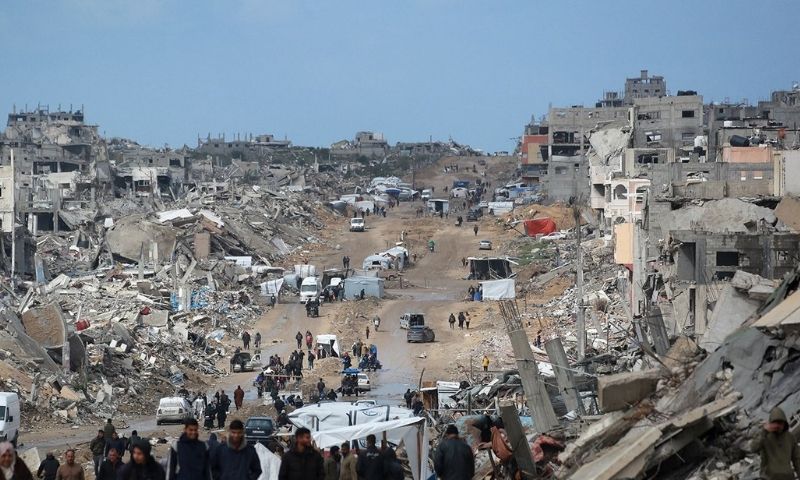
More than 80 percent of all buildings in Gaza have been damaged or destroyed in Israel’s bombardment campaign.
Hamas has not commented on Witkoff’s announcement.
The Palestinian group previously said it was ready to abandon day-to-day governance in Gaza as outlined under the Trump plan.
The 20-point US proposal, initially put forward in September, also includes the establishment of a “Board of Peace” chaired by Trump and the deployment of an “international stabilisation force” to oversee security in Gaza.
Last week, Netanyahu said former United Nations Middle East envoy Nickolay Mladenov would lead the board, which will be tasked with overseeing the Palestinian technocratic government governing Gaza.
Meanwhile, the UN and leading humanitarian groups working in Gaza continue to call on Israel to allow unimpeded deliveries of aid into the territory, including food, shelter supplies, and equipment needed to clear rubble and rebuild homes.
Legal experts have noted that the continued restrictions violate Israel’s obligation to provide for the needs of Palestinians in the territory under its occupation.
They also contravene the US-brokered ceasefire agreement, which ordered Israel to allow 600 aid trucks into the enclave daily.
More than 71,400 Palestinians have been killed and more than 171,000 others wounded in Israel’s bombardment campaign in Gaza since October 2023.