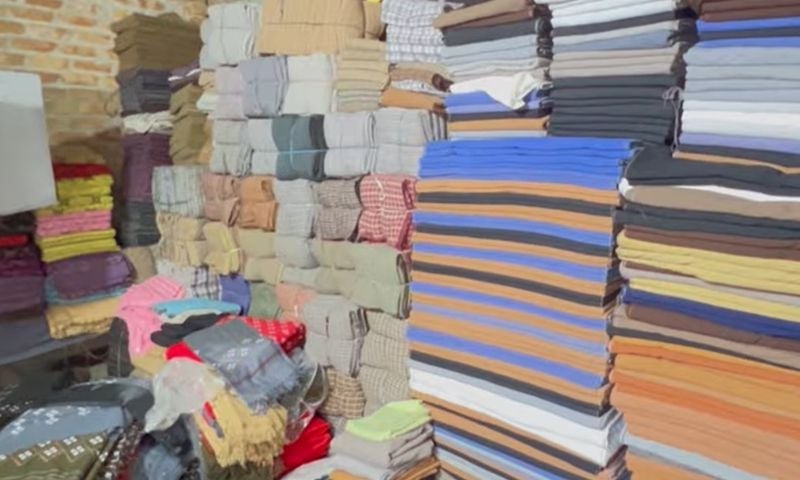
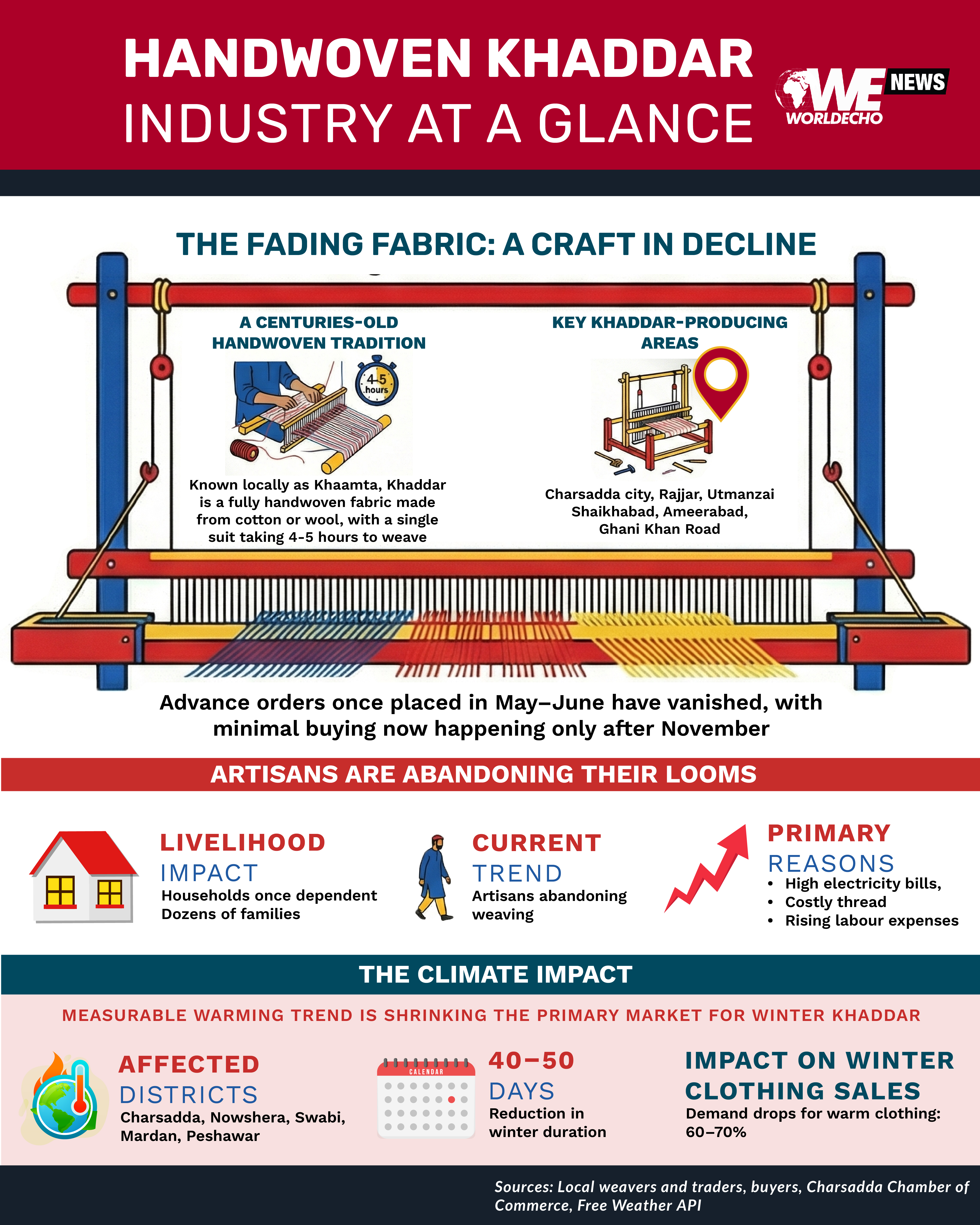
CHARSADDA, Pakistan: The centuries-old, handwoven traditional Khaddar — locally known as Khaamta, which was once the fabric of everyday life in Charsadda — is now fighting a losing battle for survival.
Local artisans and shopkeepers of Charsadda — about 35 kilometres northeast of Peshawar — warn that a toxic mix of climate change, shrinking winters, and soaring raw material costs has pushed the Khaddar industry to the edge of the abyss.
Traditionally woven on simple wooden looms, Khaddar is mostly made from cotton, while a wool or cotton-wool blend is used for winter wear.
Cotton khaddar is light, breathable, and well-suited to the region’s climate, while woollen Khaddar provides much-needed warmth during colder days.
The fabric is produced entirely by hand using age-old techniques passed down through generations, making each piece a labour of patience and skill.
Bacha Khan’s cultural legacy
Not long ago, areas such as Charsadda city, Rajjar, Utmanzai, and surrounding villages relied heavily on Khaddar production as a primary source of livelihood.
Today, however, this once-thriving cottage industry is rapidly unravelling. Many artisans now fear they may be the last custodians of a craft that has survived for centuries.
“Customers simply don’t turn up the way they used to, because winters now come in short, sharp bursts and disappear just as quickly.”– Bilal Ahmed, a retailer
Syed Shah Raza Shah — a local journalist well-versed with Khyber Pakhtunkhwa (KP)’s political movements — recalls that during the era of Khan Abdul Ghaffar Khan — lovingly called Bacha Khan a legendary Pashtun leader and social reformer — Khaddar was often viewed as a symbol of poverty, while Khans and affluent families preferred costly imported fabrics that signified status and prestige.
Despite hailing from a Khan family himself, Bacha Khan consciously chose to wear Khaddar, challenging deep-rooted social prejudices and redefining dignity through simplicity.
By leading from the front, he altered public perception and encouraged the members of the Khudai Khidmatgar (Servants of God) movement to wear Khaddar as a symbol of equality, self-respect, and resistance to excess.
He also championed the use of local products and spoke out against wasteful traditions, personally travelling across regions to raise awareness, Shah notes.
Khaddar markets grow silent
Bilal Ahmed, 42, a retailer selling jackets, sweaters, and coats in Charsadda, informs WE News English that his business has been on a downward spiral for years.
“People now prefer lighter, adaptable clothing that can be layered in winter and worn alone when the weather shifts.” – Muhammad Arsalan, local shopkeeper
“Customers simply don’t turn up the way they used to, because winters now come in short, sharp bursts and disappear just as quickly,” he observes.
He notes that many traders have already thrown in the towel. Winter merchandise must be ordered months in advance, but weak sales leave piles of unsold stock, which becomes obsolete when new fashions arrive the following year.
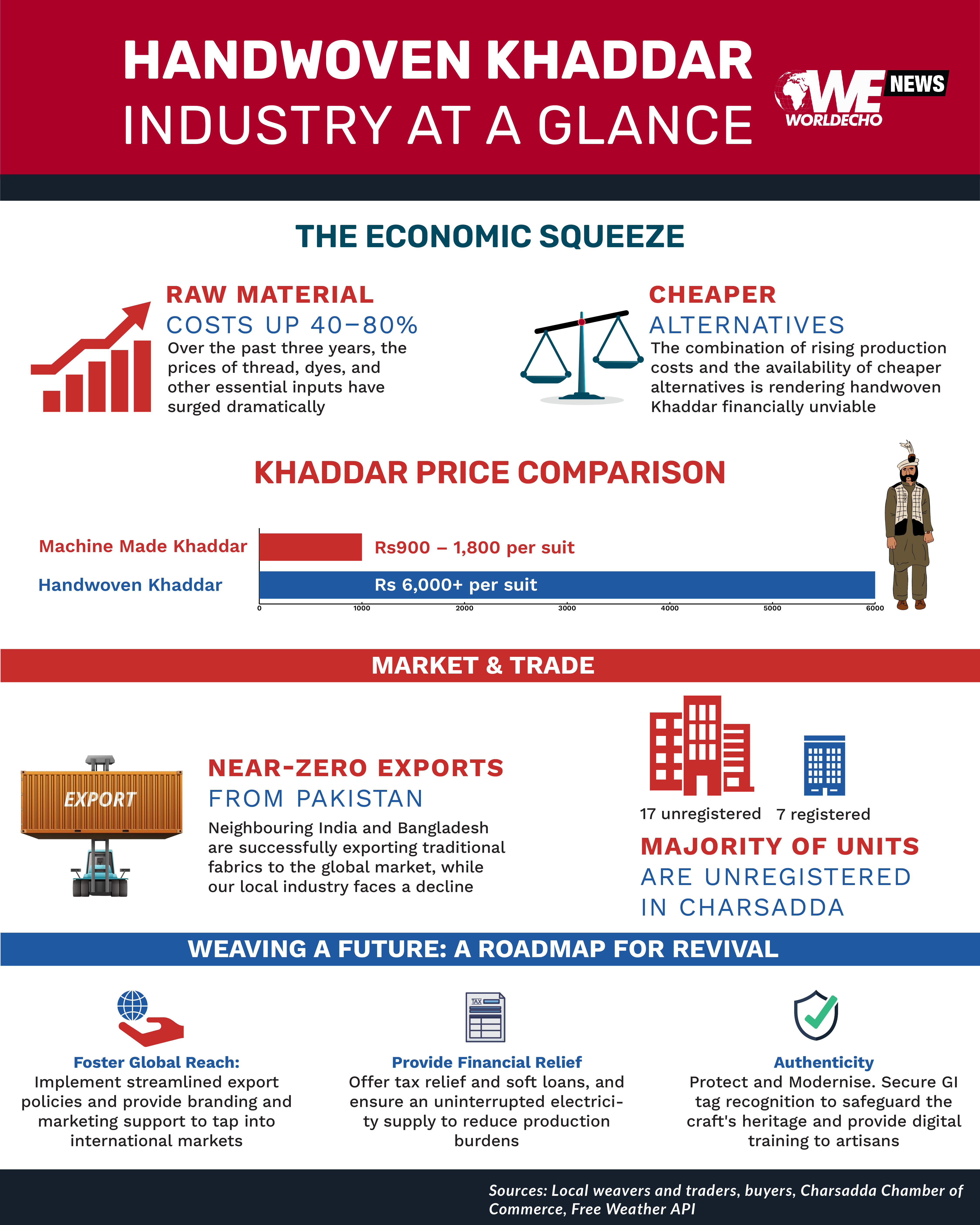
Inflation has also added fuel to the fire. Prices of thread, dyes, and other essential materials used in Khaddar production have surged by 40 to 60 per cent over the past three years, Ihsan points out, squeezing artisans’ already thin margins.
Muhammad Arsalan, 32, a local shopkeeper, says Khaddar offers excellent warmth, but shorter winters and longer summers have changed buying habits.
“People now prefer lighter, adaptable clothing that can be layered in winter and worn alone when the weather shifts,” he observes.
Shadman Khan, 42, a resident of Rajjar and a Khaddar artisan for more than two decades, echoes Arsalan’s concerns.
“Khaddar has become expensive to produce, but people’s purchasing power has shrunk. We cannot raise prices, so our labour brings little to no return.”
He explains that the prices depend on yarn quality, with handwoven Khaddar costing Rs6,000 or more, compared to Rs900 to Rs1,800 for machine-made fabric.
“In earlier years, we received advance orders as early as May and June for the coming winter. This year, even our regular customers dragged their feet, and those who did place orders kept quantities painfully low.” – Shadman Khan, Khaddar artisan
Data obtained from the Charsadda Chamber of Commerce reveals that 24 Khaddar manufacturing units operate in Charsadda district — seven registered with the Charsadda Chamber of Commerce, and 17 unregistered — mainly located in Shaikhabad, Rajjar, Ameerabad, Ghani Khan Road, and Utmanzai.
“In earlier years, we received advance orders as early as May and June for the coming winter. This year, even our regular customers dragged their feet, and those who did place orders kept quantities painfully low,” Shadman Khan shares.
He explains that when winter arrives late, consumer interest melts away. “In the past, September and October were peak months. Now, even after November, the markets wear a deserted look,” he says.
If these conditions persist, handwoven Khaddar could vanish into thin air within a few years, he fears.
Climate chills trade
Another major concern is the steadily shrinking winter season. Muhammad Ihsan — a local shopkeeper associated with Khaddar production and sales — points out that winter in Peshawar Valley, comprising Charsadda, Nowshera, Swabi, Mardan, and Peshawar districts, have shortened by nearly 40 to 50 days over the past decade.
As a direct consequence, demand for warm clothing has plummeted by 60 to 70 per cent. He adds that when cold temperatures fail to set in, buyers stay away and markets remain eerily quiet.
Prof Hizbullah Khan, from the Department of Environmental Sciences at the University of Peshawar, explains that rising greenhouse gas emissions have driven a steady increase in temperatures, intensifying weather volatility.
“We are witnessing more extreme and erratic weather patterns — prolonged heatwaves punctuated by short spells of unusual cold — making seasons increasingly unpredictable,” he remarks.
This climatic imbalance is taking a toll on agriculture, public health, and the local economies. Sudden temperature shifts damage crops, raise disease risk, and disrupt daily life. Without urgent measures to curb emissions, climate uncertainty will only deepen, he cautions.
“We are witnessing more extreme and erratic weather patterns — prolonged heatwaves punctuated by short spells of unusual cold — making seasons increasingly unpredictable.” – Prof Hizbullah Khan, University of Peshawar
Heat creeps into winter
Weather trends back these concerns with hard numbers. Data from Free Weather API shows a steady rise in temperatures between 2022 and 2024. January averages hovered between 11°C and 14°C, while July temperatures climbed from 32°C in 2022 to 36°C in 2024.
Historical climate data paints a similar picture. Between 1991 and 2020, December averaged 11.9°C and January 10.5°C.
In recent years, December temperatures have jumped to 13–15°C, while January averages range from 11–14°C. The region has warmed by roughly 0.24°C per decade, confirming that winters are becoming both warmer and shorter.
Woven identity fades
Dozens of families once relied entirely on Khaddar weaving, but many artisans are abandoning the craft because of high electricity bills, expensive thread, and increasing labour expenses.
The rhythmic clatter of looms — once the soundtrack of many homes — has fallen silent.
Veteran weaver Shah Zaman Khan recalls that earlier it took just an hour to produce a Khaddar suit, and it sold quickly.
“Now, even after a full day’s work, buyers are hard to find,” he notes, adding that he sold three electric machines last year as business collapsed.
Government neglect has further deepened the crisis.
Noman Akbar Jan Khan, Senior Vice President of the Charsadda Chamber of Commerce, observes that no concrete policy exists to protect the Khaddar industry.
“Our artisans have sustained this craft for a century, but official apathy has left them economically stranded,” he adds.
He notes that Khaddar exports from Pakistan are virtually nonexistent, while countries like India and Bangladesh successfully market traditional fabrics worldwide.
He demands easy export policies, tax relief, uninterrupted electricity, branding support, and Geographical Indication (GI)-tag recognition, along with digital training and soft loans.
Khaddar is more than cloth — it is cultural memory woven into fabric, imbued with the scent of handmade effort and the soul of rural craftsmanship.