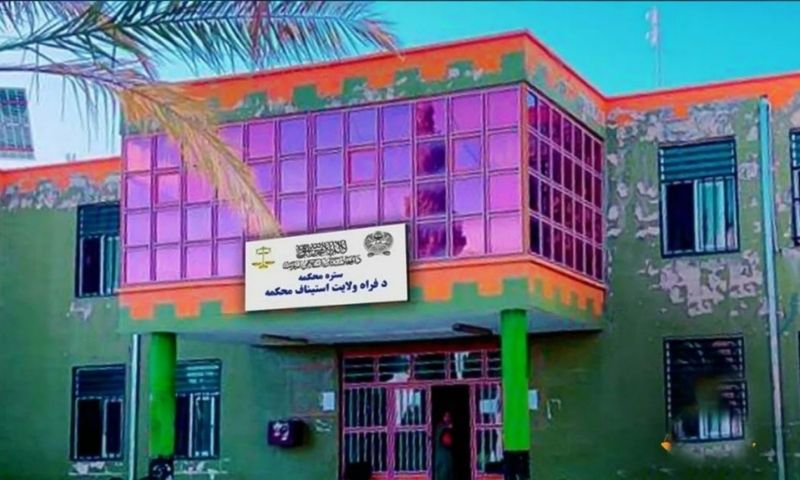



KABUL: Residents of Afghanistan’s western Farah Province say Taliban-run courts are failing to deliver justice, with civil cases mired in lengthy delays, bureaucratic hurdles, and alleged mistreatment by judges.
According to residents, civil cases routinely take months or even years to advance, with many ultimately referred to Kandahar without any final ruling, leaving plaintiffs in prolonged uncertainty.
Residents allege that instead of resolving disputes locally, Taliban courts in Farah frequently transfer cases to Kandahar, where files often sit untouched for at least a year.
Those who travel there to follow up are commonly told to return later, sometimes after another year, as earlier cases remain unreviewed, according to a report published in Hasht-e-Subh Daily, an independent Afghan newspaper.
After taking control of Afghanistan in 2021, the Taliban stripped the Office of the Attorney General of its authority to investigate and oversee civil and criminal cases. That authority was temporarily transferred to the group’s intelligence administration under an order issued by Taliban supreme leader Hibatullah Akhundzada.
Former prosecutors have warned that removing the Attorney General’s Office from judicial proceedings has rendered Taliban courts ineffective and unprofessional, particularly in criminal cases. They say legal institutions are now dominated by chaos, lacking proper mechanisms to register claims or process cases.
Human rights organizations have also raised concerns about the Taliban’s judicial system.
In a report, Richard Bennett, the United Nations Special Rapporteur on human rights in Afghanistan, said the legal system under Taliban control is designed to enforce and preserve the group’s repressive and misogynistic ideology.
He warned that for women and girls, the system not only restricts access to justice and protection but also entrenches discrimination and gender-based domination in law, policy, and everyday life.
Several residents also criticize the conduct of the head of the Taliban’s civil court in Farah, Haji Mawlawi Abdul Khaliq Ishaqzai. They accuse him of humiliating petitioners, silencing them through insults, and refusing to listen to complaints.
According to residents, he frequently refers to petitioners as “stupid” and “ignorant,” discouraging people from seeking justice.
Residents describe a system plagued by excessive paperwork, bribery, and deliberate stalling. They point to a stark contrast between how political and civil cases are handled.
Political cases, they say, are processed rapidly, with individuals appearing before Taliban courts and being sent to prison almost immediately. Civil disputes, however, often languish for months before being forwarded to Kandahar, where progress remains minimal.
One Farah resident involved in a civil dispute with a business partner over the sale of property said his case has remained unresolved for more than a year. He described repeated visits to the Taliban court as emotionally draining.
“I became completely exhausted and full of resentment,” he said. “I have documents, but I have been going back and forth for a year. There has not been even one percent progress, and nothing comes of it.”
He said that after nearly a year of follow-ups and document preparation, Taliban officials referred his case to Kandahar. There, he spent two months attempting to pursue the matter, only to be told to return after another year.
“They said last year’s petitions and cases had still not been reviewed,” he said. “They told me it was not my turn yet. By then, who knows whether I would be alive or dead.”
Another Farah resident, who requested anonymity for security reasons, echoed similar concerns, saying even simple civil cases that require minimal documentation receive no attention from Taliban judges.
According to this resident, at least six people have been killed in the past 20 days due to unresolved civil disputes. Despite this, he said, the judicial process remains largely inactive.
“There are no independent media here to carry the people’s voice,” he said. “Civil cases in Taliban courts are not handled at all. If the issue is political, the person goes to prison immediately. Haji Mawlawi Abdul Khaliq Ishaqzai does nothing.”
He also described the civil court chief as having a volatile temperament. “When you try to speak, he says, ‘Shut up, idiot, do not talk nonsense,’” the resident said. “He is almost always angry. He does not listen to people’s complaints and does not even allow them to speak.”
These accounts align with earlier complaints from residents in other provinces who have described Taliban courts as slow, opaque, and deeply unjust. Many say that because all final decisions are issued from Kandahar, the growing backlog of cases has resulted in months or years of delays.