


KEY POINTS
- Guterres urges respect for sovereignty and political independence of states.
- The UN Security Council met in emergency session after US forces captured Maduro.
- Guterres says the crisis could still be contained through dialogue and respect for international law.
- Trump signals a temporary US role in Venezuela’s governance.
- Venezuela condemned the move as a “military aggression” and “colonial war”.
- China and Russia denounced the US military operation in Venezuela.
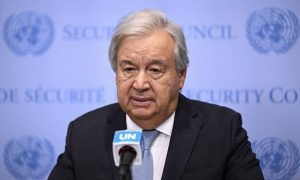
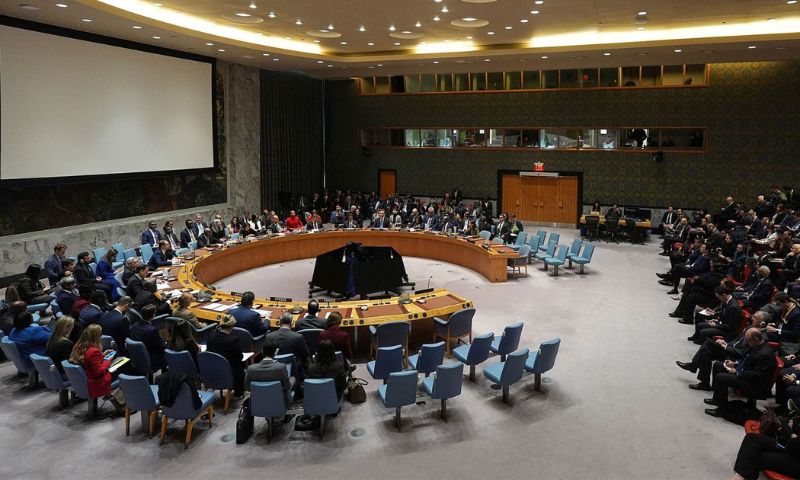
UNITED NATIONS: UN Secretary-General Antonio Guterres on Monday urged full respect for national sovereignty and political independence as the UN Security Council met in emergency session over the United States’ military operation in Venezuela and the capture of president Nicolas Maduro.
The meeting was convened after US forces carried out a military strike in Caracas on Saturday, removed Maduro from office and transferred him to the United States, where he appeared in a New York court on Monday to face narcotrafficking charges. His wife, Cilia Flores, is also in US custody.
In remarks read on his behalf by Under-Secretary-General for Political and Peacebuilding Affairs Rosemary DiCarlo, Guterres said he was “deeply concerned” about the escalation.
“He urges respect for the principles of sovereignty, political independence and territorial integrity of states,” DiCarlo told the Council.
“The world is facing the possible intensification of instability in Venezuela, the potential impact on the region, and the precedent this may set for relations between and among states,” she added.
Guterres warned that the situation could still be contained. “The situation is critical, but it is still possible to prevent a wider and more destructive conflagration,” DiCarlo said, urging inclusive dialogue and stressing that “the power of the law must prevail”.
Emergency UN Security Council session
The emergency meeting was requested by Venezuela and formally relayed to the Council by Colombia, which has been a non-permanent member since January 1. China and Russia also supported the call.
The session is being held under the agenda item “Threats to International Peace and Security,” reflecting growing concern among several UN members that the crisis has moved beyond bilateral tensions and now poses wider regional and global risks.
In a statement issued earlier through his spokesperson Stephane Dujarric, Guterres said he was “deeply alarmed” by the US military action and warned that it constituted “a dangerous precedent” for the international order.
‘No war against Venezuela or its people’
US Ambassador to the United Nations Mike Waltz addressed the Security Council meeting on Venezuela.
“There is no war against Venezuela or its people. We are not occupying a country. This was a law enforcement operation,” he said of the raid in which Maduro was captured.
“The overwhelming evidence of his crimes will be presented openly in US court proceedings,” Waltz said.
“I want to reiterate that President Trump gave diplomacy a chance. He offered Maduro multiple off-ramps. He tried to de-escalate. Maduro refused to take them.”
He added that the US will not waver in its actions to “protect Americans from the scourge of narco-terrorism and seek peace, liberty and justice for the great people of Venezuela.”
China calls US action ‘illegal and bullying’
China called on the US to release Maduro and his wife, its deputy UN representative Sun Lei told the Security Council.
“China is deeply shocked by and strongly condemns the unilateral, illegal and bullying acts of the US,” said Sun through an interpreter.
“We demand that the United States change its course, cease its bullying and coercive practices, and develop relations and cooperation with regional countries on the basis of mutual respect, equality and non-interference in international affairs.”
Russia says no justification for US ‘crimes’ in Venezuela
Russia condemns the US for what it called the “act of armed aggression” against Venezuela, its UN envoy Vassily Nebenzia told the Security Council.
“There is no and can be no justification for the crimes cynically perpetrated by the United States in Caracas. We firmly condemn the US act of armed aggression against Venezuela, in breach of all international legal norms,” Nebenzia said through an interpreter.
Russia also called on the US to release Maduro and his wife.
US operation and justification
US President Donald Trump described the operation as a decisive move against an authoritarian leader accused of narco-terrorism and criminal activity.
Trump said the United States would “run the country until such time as we can do a safe, proper and judicious transition,” signalling an interim American role in Venezuela’s governance.
Washington has framed the operation as a law-enforcement and security action.
Venezuela condemns ‘act of aggression’
Venezuela has strongly condemned the US action. In a letter to the Security Council, Venezuela’s UN ambassador Samuel Moncada described the operation as “a military aggression” and “a colonial war”.
He said it aimed to impose “a puppet government” and to plunder Venezuela’s natural resources, including its vast oil reserves.
Moncada cited the UN Charter, which states that all members must refrain from the threat or use of force against the territorial integrity or political independence of any state.
China and Russia denounce action
China and Russia condemned the US military operation in Venezuela.
China’s foreign ministry said it was “deeply shocked” by the use of force against a sovereign state and demanded the immediate release of Maduro and his wife.
Foreign ministry spokesperson Lin Jian said China supported the Security Council’s emergency meeting and called on the United States to resolve the issue through dialogue and negotiation.
Russia’s foreign ministry described the operation as an act of armed aggression and said Latin America must remain “a zone of peace”, warning against any military interference in Venezuela’s internal affairs.
Both Beijing and Moscow stressed that their stance was based on defending core principles of international law, not on support for Maduro personally.
Regional and legal concerns
Reactions across Latin America have been mixed. Some governments have welcomed Maduro’s removal as the end of an authoritarian era, while others have warned of renewed instability and possible humanitarian fallout.
Colombia, which borders Venezuela, said it was concerned about border security and potential displacement.
Divisions are expected inside the UN Security Council. China and Russia are likely to press arguments that the US action violates international law, while the United States is expected to defend its operation on security grounds.
Any resolution critical of Washington is expected to face a veto, limiting the prospects for formal Council action.