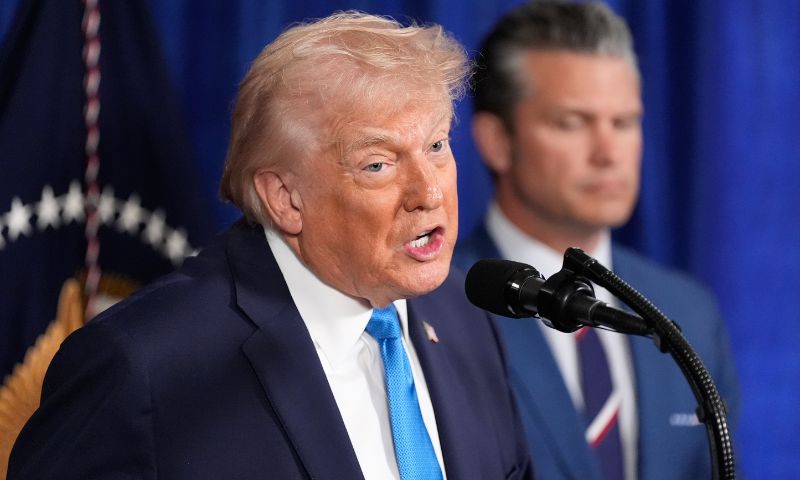
WASHINGTON: U.S. President Donald Trump on Sunday signaled that the United States could carry out a second military strike in Venezuela if officials remaining in the government fail to cooperate with Washington’s efforts to stabilize the country.
The warning comes after a high-profile U.S. operation captured President Nicolás Maduro, who is now held in New York on drug-related charges. Trump also suggested that similar measures could be applied to neighboring countries that do not curb the flow of illicit drugs into the United States, emphasizing that Washington intends to oversee Venezuela’s recovery while securing strategic interests, including access to its vast oil reserves.
Speaking to reporters aboard Air Force One, Trump outlined a firm approach to the situation in Venezuela following the capture of President Nicolás Maduro, suggesting that further action could be taken if cooperation falters, according to AFP.
He also raised the possibility of intensified measures toward other neighboring countries if they do not act to curb the flow of illicit drugs into the United States.
“Operation Colombia sounds good to me,” Trump commented, adding that Cuba, a longstanding ally of Venezuela, “looks like it’s ready to fall” without the need for U.S. military action.
Pressed on questions about leadership in Venezuela, Trump asserted that the United States was in control of the situation after Maduro’s capture, while also engaging with the new leadership in Caracas.
“We’re dealing with the people who just got sworn in. Don’t ask me who’s in charge because I’ll give you an answer and it’ll be very controversial,” Trump said when asked if he had spoken to interim leader Delcy Rodriguez. “It means we’re in charge,” he added.
When asked whether the mission was driven by oil interests or regime change, Trump responded, “It’s about peace on earth,” and emphasized that elections in Venezuela would be organized at an appropriate time once stabilization is underway.
“We’re going to run it, fix it, we’ll have elections at the right time, but the main thing you have to fix is it’s a broken country,” he said, underscoring the administration’s focus on rebuilding.
Trump also addressed other U.S. foreign policy concerns, warning that leaders not cooperating with U.S. objectives “will not be doing it very long,” while reiterating strong rhetoric toward Cuba and Iran.
From Washington’s perspective, the administration says it is prepared to work with remaining Venezuelan government officials, provided that U.S. goals — particularly broader access to the country’s significant crude oil resources — are supported.
Maduro is currently held in a New York detention facility and is due in court on Monday on drug-related charges. His removal has generated significant uncertainty about Venezuela’s future governance.
Top Venezuelan officials, however, have rejected the U.S. operation as illegitimate. They describe the capture of Maduro and his wife, Cilia Flores, as a kidnapping, and maintain that Maduro remains the country’s rightful president.
“Here, there is only one president, whose name is Nicolás Maduro Moros. Let no one fall for the enemy’s provocations,” Interior Minister Diosdado Cabello said in an audio statement released by the ruling PSUV party.
Images circulating of the 63-year-old Maduro blindfolded and handcuffed have drawn global attention and shock among Venezuelans. The operation marks the most significant U.S. military intervention in Latin America in decades.
Defense Minister General Vladimir Padrino, appearing on state television, confirmed that Venezuelan soldiers and civilians, including members of Maduro’s security detail, were killed during the operation. He declared that the armed forces have been mobilized to defend Venezuela’s sovereignty.
The Cuban government also reported casualties among its citizens during the raid.
In the wake of Maduro’s detention, Vice President Delcy Rodriguez — who also serves as Venezuela’s oil minister — has been sworn in as interim leader with support from the nation’s highest court, though her position is contested internationally.
Who will run Venezuela?
Despite the success of the initial U.S. operation, questions remain about the strategy moving forward. President Trump has stated that the U.S. will oversee the country’s recovery, while Secretary of State Marco Rubio clarified that Washington’s focus is on combating drug trafficking rather than seeking full regime change.
Rubio noted that U.S. naval forces would maintain a strong presence in the Caribbean to uphold a blockade on Venezuelan oil exports, citing this as a strategic lever in negotiations.
With Capitol Hill engaged over the evolving situation, administration officials say Secretary Rubio is preparing to brief lawmakers on the U.S. strategy.
The Trump administration’s stance emphasizes guiding Venezuela through transition while securing American interests, especially access to the country’s vast oil reserves.
As news of Maduro’s detention spread, Venezuelan expatriates celebrated in cities worldwide. Millions of Venezuelans have fled their homeland in recent years amid economic collapse and political repression.
Delcy Rodriguez, often seen as the most pragmatic figure within Maduro’s circle, has publicly expressed openness to cooperation with the U.S., though she has also contradicted some of Trump’s claims about her willingness to align with Washington.
Trump suggested in an interview with The Atlantic that Rodriguez “may pay a bigger price than Maduro” if she fails to follow through on necessary reforms, a comment that has not yet prompted a response from Venezuela’s communications ministry.