Key points
- Seventh foreign ministers’ dialogue held in Beijing
- Both sides back CPEC 2.0 expansion
- Mutual support pledged on core interests
ISLAMABAD: China and Pakistan strengthened their strategic partnership during the Seventh Round of the China-Pakistan Foreign Ministers’ Strategic Dialogue in Beijing, pledging to advance CPEC 2.0 projects, enhance security cooperation, and coordinate on regional and global issues, officials said Monday.
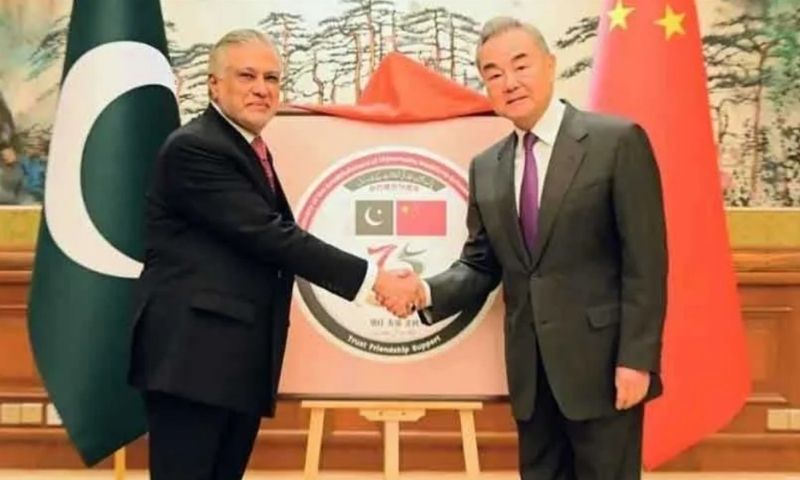
The talks, co-chaired by Chinese Foreign Minister Wang Yi and Pakistan’s Deputy Prime Minister and Foreign Minister Mohammad Ishaq Dar, focused on deepening bilateral cooperation across political, economic, security, and cultural sectors, advancing CPEC 2.0, and pledging mutual support on core national interests.
The talks took place during a three-day visit to China by Pakistan’s Deputy Prime Minister and Foreign Minister Mohammad Ishaq Dar, at the invitation of Chinese Foreign Minister Wang Yi.
According to a joint press communiqué, the meeting focused on strengthening bilateral relations and expanding cooperation across political, economic, security, and cultural domains.
Broad review of bilateral cooperation
During the dialogue, the two sides conducted what they described as a comprehensive exchange of views on strategic and political cooperation, defence and security ties, trade, investment, and people-to-people exchanges. International and regional developments of mutual concern were also discussed.
Both sides agreed to enhance strategic communication, deepen mutual trust, and jointly safeguard their shared interests. They emphasised the importance of bilateral cooperation for promoting economic and social development in both countries, as well as for contributing to regional peace and stability.
75 years of diplomatic relations
China and Pakistan announced that 2026 will mark the 75th anniversary of the establishment of diplomatic relations between the two countries. A series of commemorative activities will be launched to mark the occasion, to consolidate bilateral friendship and identify new areas of cooperation.
The communiqué described China-Pakistan relations as an “all-weather strategic cooperative partnership” and noted that high-level exchanges remain a defining feature of bilateral ties.
Both sides reiterated their commitment to implementing the Action Plan to Foster an Even Closer China-Pakistan Community with a Shared Future (2025–2029).
The two countries reaffirmed their support for each other on issues described as core national interests. Pakistan reiterated its commitment to the one-China principle and stated that Taiwan is an inalienable part of China’s territory. Islamabad also expressed support for China’s positions on Xinjiang, Xizang, Hong Kong, and the South China Sea.
China reiterated its support for Pakistan’s sovereignty, independence, and territorial integrity. Beijing expressed backing for Pakistan’s efforts to pursue a development path suited to its national conditions, combat terrorism, and play a greater role in regional and international affairs.
Security and counter-terrorism cooperation
Counter-terrorism cooperation featured prominently in the discussions. China commended Pakistan for measures taken to combat terrorism and ensure the safety of Chinese personnel, projects and institutions in Pakistan.
Beijing also recognised Pakistan’s contributions and sacrifices in counter-terrorism efforts over the years.
Both sides reaffirmed a policy of zero tolerance towards terrorism in all its forms and agreed to deepen cooperation on security matters. They stressed the importance of ensuring that Belt and Road Initiative projects, including those under the China-Pakistan Economic Corridor (CPEC), progress in a secure and stable environment.
The dialogue placed significant emphasis on economic cooperation, particularly the advancement of an upgraded “CPEC 2.0”. The two sides agreed to align their development strategies and focus on key sectors, including industry, agriculture, and mining.
Plans were discussed to promote the development and operation of Gwadar Port, ensure smooth connectivity along the Karakoram Highway, and enhance Pakistan’s capacity for sustainable development.
Cooperation in trade, investment, information technology, science and technology, education, vocational training, and cultural exchanges was also highlighted.
The year-round opening of the Khunjerab Pass was identified as an opportunity to increase cross-border trade and people-to-people contacts. Both sides welcomed third-party participation in CPEC projects, subject to agreed frameworks.
Regional and global issues
The ministers exchanged views on regional developments, including South Asia, Afghanistan, and the Middle East. China reiterated that the Jammu and Kashmir dispute should be resolved peacefully in accordance with relevant United Nations resolutions and bilateral agreements.
On Afghanistan, the two sides agreed to maintain close coordination and called on the Afghan authorities to adopt inclusive policies, focus on development and prevent terrorist groups from operating from Afghan territory.
China and Pakistan also called for an unconditional and permanent ceasefire in Gaza and reaffirmed support for a two-state solution to the Palestinian issue.
Both countries expressed support for multilateralism, the United Nations Charter, and global initiatives related to development, security, and governance. China congratulated Pakistan on its role at the UN Security Council and expressed support for Pakistan’s upcoming presidency of the Shanghai Cooperation Organisation.