KEY POINTS
- Dar co-chaired 7th Pakistan–China Strategic Dialogue in Beijing.
- Talks reviewed full spectrum of Pakistan–China bilateral relations.
- Regional and global developments discussed during high-level engagement.
- CPEC cooperation remained central to bilateral discussions.
- Trade and economic ties reviewed for further expansion.
- Both sides stressed coordination at bilateral and multilateral forums.
- 75th anniversary of diplomatic ties to be marked befittingly.
- Dar met Chinese Vice Premier Ding Xuexiang during visit.
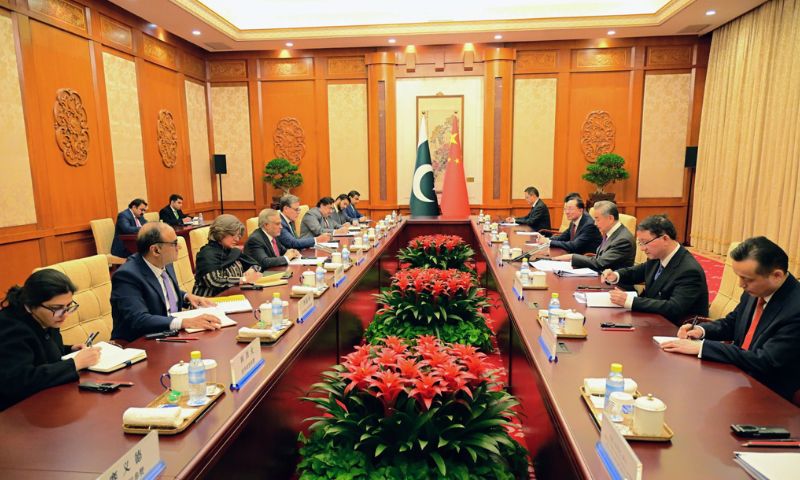
ISLAMABAD: Pakistan’s Deputy Prime Minister and Foreign Minister Senator Mohammad Ishaq Dar co-chaired on Monday the 7th Round of the Pakistan–China Foreign Ministers’ Strategic Dialogue in Beijing, reaffirming the two countries’ commitment to deepening their longstanding “All-Weather Strategic Cooperative Partnership.”
Strategic dialogue held
According to an official statement, Dar visited Beijing at the invitation of Chinese Foreign Minister Wang Yi, where the two sides conducted an extensive review of the entire spectrum of bilateral relations and exchanged views on key regional and global developments.
The dialogue covered a wide range of issues, including cooperation under the China–Pakistan Economic Corridor (CPEC), trade and economic ties, multilateral coordination, and people-to-people exchanges.
Both sides underlined the importance of maintaining close coordination amid evolving regional and international dynamics.
All-weather partnership
Highlighting the strategic importance of Pakistan–China relations, Dar and Wang Yi reaffirmed that the enduring friendship between the two countries remains vital for peace, stability and prosperity in the region, as well as for the long-term development goals of both nations.
“The two leaders emphasised the salience of the All-Weather Strategic Cooperative Partnership and agreed to further strengthen coordination at both bilateral and multilateral fora,” the statement said.
Discussions on CPEC focused on enhancing cooperation in existing and new areas, with an emphasis on economic connectivity, development, and mutual benefit.
At the invitation of Chinese Foreign Minister Wang Yi, DPM/FM Senator Mohammad Ishaq Dar @MIshaqDar50 visited Beijing to co-chair the 7th Round of the Pakistan–China Foreign Ministers’ Strategic Dialogue.
The two sides reviewed the entire spectrum of Pakistan–China relations and… pic.twitter.com/G2GeJ9Kxye
— Ministry of Foreign Affairs – Pakistan (@ForeignOfficePk) January 4, 2026
The two sides also explored avenues to expand trade and deepen collaboration within regional and international platforms.
People-to-people links
People-to-people contacts, including cultural exchanges and educational cooperation, were identified as an important pillar of the relationship, with both countries agreeing to encourage greater engagement between their societies.
In addition, Dar and Wang Yi agreed to mark the 75th anniversary of the establishment of diplomatic relations between Pakistan and China in a “befitting manner,” underscoring the historical depth and future potential of the bilateral partnership.
DPM/FM Senator Mohammad Ishaq Dar @MIshaqDar50 and Chinese Foreign Minister Wang Yi jointly unveiled the logo marking the 75th anniversary of Pakistan-China diplomatic relations. The launch heralds a year-long series of celebrations to honor this historic milestone, reflect on… pic.twitter.com/DR6vMi8Ik1
— Ministry of Foreign Affairs – Pakistan (@ForeignOfficePk) January 4, 2026
The visit comes at a time of heightened geopolitical uncertainty, with both Islamabad and Beijing stressing the need for close diplomatic engagement and policy coordination to address shared challenges at the regional and global levels.
Meeting vice premier
Ishaq Dar also met Executive Vice Premier of China Ding Xuexiang in Beijing, with both sides reaffirming their commitment to further deepening the Pakistan–China All-Weather Strategic Cooperative Partnership.
According to the Ministry of Foreign Affairs, the meeting focused on strengthening bilateral cooperation and reviewing the broad contours of Pakistan–China relations.
Vice Premier Ding appreciated Pakistan’s consistent support for China on issues of its core interest, underscoring the high level of mutual trust between the two countries.
The two leaders highlighted the historic importance of the 75th anniversary of the establishment of diplomatic relations between Pakistan and China, agreeing to use the milestone to shape a forward-looking vision for enhanced cooperation across multiple sectors.
Discussions also included cooperation under the China–Pakistan Economic Corridor (CPEC), with both sides reiterating their commitment to advancing the flagship project as a key pillar of the bilateral relationship.
They emphasised the need to expand collaboration in areas that promote economic growth, connectivity, and shared development.
Vice Premier Ding extended New Year greetings to the leadership and people of Pakistan, a gesture reflecting the close and cordial nature of ties between the two countries.
Deputy Prime Minister/Foreign Minister, Senator Mohammad Ishaq Dar @MIshaqDar50, met the Executive Vice Premier of China, Mr. Ding Xuexiang, in Beijing.
The two sides reaffirmed their shared commitment to further deepening the Pakistan–China All-Weather Strategic Cooperative… pic.twitter.com/KXJ8fZ8iMW
— Ministry of Foreign Affairs – Pakistan (@ForeignOfficePk) January 4, 2026
Bilateral relations overview
Pakistan and China established diplomatic relations in 1951, and over the decades their ties have evolved into what both sides describe as an “All-Weather Strategic Cooperative Partnership.”
The relationship spans political, economic, military, and diplomatic cooperation, with strong alignment on regional and international issues.
A cornerstone of the partnership is the China–Pakistan Economic Corridor, launched in 2015 as part of China’s Belt and Road Initiative.
CPEC includes infrastructure, energy, and connectivity projects aimed at boosting Pakistan’s economic development and regional integration.
The Pakistan–China Foreign Ministers’ Strategic Dialogue serves as a key institutional mechanism to review bilateral relations and coordinate positions on regional and global developments.
The 7th round reflects continued high-level engagement between the two countries as they prepare to celebrate 75 years of diplomatic ties in 2026.