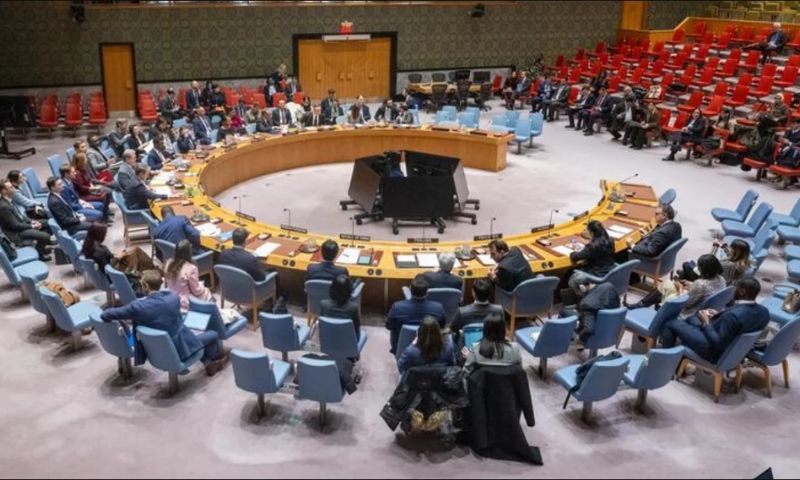



UNITED NATIONS: The UN Security Council will hold an emergency session on Monday amid mounting international alarm over US military action in Venezuela, with concerns that the crisis has moved beyond bilateral tensions.
On Saturday, UN Secretary General Antonio Guterres warned that the crisis in Venezuela could undermine the foundations of international law by setting a “dangerous precedent” for similar actions in the near future.
The meeting was requested by Colombia and supported by China and Russia, with Venezuela also formally appealing to the Council.
According to the Council presidency, the session will be held under the agenda item “Threats to International Peace and Security,” and the Secretary General is expected to brief the members.
In a statement issued through his spokesperson, Stephane Dujarric, Secretary General Guterres said he was “deeply alarmed by the recent escalation in Venezuela, culminating with Saturday’s United States military action in the country, which has potential worrying implications for the region.”
The statement added: “Independently of the situation in Venezuela, these developments constitute a dangerous precedent.”
“The secretary general continues to emphasise the importance of full respect — by all — of international law, including the UN Charter,” Dujarric said. “He’s deeply concerned that the rules of international law have not been respected.”
Risk to regional stability
The decision to convene the Council reflects a growing view among several UN members that the crisis has moved beyond bilateral tensions and now poses broader risks to regional stability and the international system itself.
The US operation, carried out overnight on Saturday, marks the most direct American military intervention in Latin America in decades.
Washington has framed the action as a decisive move against an authoritarian leader accused of narco-terrorism and criminal activity.
US President Donald Trump confirmed the operation, adding that the United States would “run the country until such time as we can do a safe, proper and judicious transition,” signalling an interim American role in Venezuela’s governance.
The UN secretary-general’s office has stressed that even severe political crises do not negate the legal restraints imposed by the UN Charter.
“Full respect — by all — of international law” remains essential, Dujarric said, warning that departures from those principles weaken the rules-based international order.
Venezuela has strongly condemned the US action, describing it as a violation of sovereignty and an act of aggression.
China, Russia condemn US actions
In a letter to the Security Council, Venezuela’s UN ambassador Samuel Moncada wrote that the operation amounted to “a colonial war aimed at destroying our republican form of government, freely chosen by our people,” and at imposing “a puppet government that allows the plundering of our natural resources, including the world’s largest oil reserves.”
Moncada cited the UN Charter directly, recalling that it states: “All members shall refrain in their international relations from the threat or use of force against the territorial integrity or political independence of any state.”
China and Russia have echoed those concerns in unusually blunt language. China’s foreign ministry said it was “deeply shocked and strongly condemns the use of force by the US against a sovereign country and the use of force against the president of a country.”
It added that China “firmly opposes such hegemonic behaviour by the US, which seriously violates international law, violates Venezuela’s sovereignty, and threatens peace and security in Latin America and the Caribbean,” and called on Washington to “abide by international law and the purposes and principles of the UN Charter.”
Russia’s foreign ministry described the operation as an act of aggression. “This morning, the United States committed an act of armed aggression against Venezuela,” it said, adding that “the pretexts used to justify such actions are unfounded.”
Moscow warned that Latin America must remain “a zone of peace” and insisted that Venezuela be allowed “to determine its own destiny without any destructive, let alone military, interference from outside.”
Both Beijing and Moscow have stressed that their objections are rooted not in support for Maduro personally, but in the defence of what they describe as core principles of international law.
Reactions from Latin America
Reactions from across Latin America have been shaped by a long history of external intervention. While some governments have welcomed Maduro’s removal as the end of a repressive era, others have warned that the US action risks renewed instability.
Colombia, which requested the Council meeting, has highlighted concerns about border security and possible displacement.
At the legal level, the episode has revived debates about the limits of unilateral action. Article 2(4) of the UN Charter requires member states to refrain from the use of force except in self-defence or with Security Council authorisation.