Key points:
- SIGAR audit exposes billions lost to waste, fraud and abuse.
- Spending prioritised speed over accountability, weakening Afghan institutions.
- US-backed government relied on corrupt powerbrokers and abusive militias.
- Billions funded ineffective programmes that often fuelled conflict and corruption.
- Afghan security forces were inflated by ghost soldiers and fake payrolls.
- Nearly $90bn spent on forces that collapsed within days.
- US continued funding phantom forces despite repeated internal warnings.
- Taliban inherited billions worth of US-funded weapons and infrastructure.
- International aid risks indirectly strengthening Taliban governance and control.
ISLAMABAD: A new damning report released by the United States reveals that one of the largest nation-building projects in history was hollowed out from within by systemic corruption, fraudulent security forces, and catastrophic waste, ultimately paving the way for the Taliban’s swift takeover and providing them with the tools to consolidate power.
The final forensic audit from the Special Inspector General for Afghanistan Reconstruction (SIGAR) paints a devastating picture of two decades of American investment compromised by graft, mismanagement, and a fundamental misunderstanding of Afghan society. The consequences are still unfolding, with the Taliban now leveraging remnants of the failed state and international aid to solidify their authoritarian rule.
“The gap between ambition and reality was vast, with deteriorating conditions continually stymying objectives that proved to be unrealistic,” the report states, summarising a mission that promised democracy and stability but delivered neither.
A republic built on sand
From the outset, the US investment was of historic proportions. “From 2002 through mid-2021, the United States Congress appropriated approximately $144.7 billion for Afghanistan reconstruction — far more than it spent on the post World-War-II Marshall Plan in inflation adjusted terms,” the report states.
Yet, this colossal effort was fundamentally compromised. “SIGAR identified 1,327 instances of waste, fraud, and abuse totalling between $26.0 billion and $29.2 billion,” according to the report.
Waste was the most prevalent issue, accounting for 93 per cent of the total amount identified.
Expert analysts argue this internal rot critically undermined the very state the US sought to build. “The US government continuously struggled to develop a coherent strategy for what it hoped to achieve,” SIGAR notes, listing systemic flaws that included “unrealistic timelines and expectations that prioritised spending quickly, which led to increased corruption and reduced program effectiveness.”
The report details how US forces, in pursuit of short-term security gains, made early and ongoing decisions to “ally with corrupt, human-rights-abusing powerbrokers,” which “bolstered the insurgency and undermined the mission, including US goals for bringing democracy and good governance to Afghanistan.”
This strategy had devastating consequences. Billions were poured into programmes that achieved little. For example, “$7.3 billion on ineffective counternarcotics programming” failed to stem opium production, with Afghanistan remaining the world’s largest supplier. Another “$4.7 billion on ineffective stabilisation programming” often backfired. “Money spent was often the metric of success, instead of more nuanced performance metrics,” SIGAR found, noting these programmes “often exacerbated conflicts, enabled corruption, and bolstered support for insurgents.”
Specific projects read like a ledger of waste: “$486 million for 20 G-222 aircraft for the Afghan Air Force that did not meet operational requirements,” later sold for scrap at six cents per pound; “$335 million for an underutilised power plant” operating at less than 1 per cent capacity; and “$85 million for an unfinished and unused hotel” near the US Embassy.
The culture of corruption was endemic. SIGAR’s investigation into a US-funded mining programme found its failure was due to “abuse of power by Afghan government officials, specifically their involvement in illegal mining operations,” which were run by or benefited members of parliament and powerful families. This environment eroded public trust to a breaking point.
The phantom army
The most shocking revelation of the 2021 collapse was the implosion of the 300,000-strong Afghan National Defence and Security Forces (ANDSF). Despite nearly “$90 billion in US appropriations for security-sector assistance,” the force disintegrated in a matter of days.
SIGAR’s report exposes this as one of the most significant security failures in modern history, rooted in a years-long ghost employees in inflated personnel rosters and salary payments phenomenon. The report highlights the absurdity of official data showing “112,924 police personnel listed in the payroll system, with 93.5 per cent present for duty” on August 14, 2021, the day before Kabul fell, while the Taliban controlled most of the country.
“We did not have a police and army that amounted to over 300,000. That was all a lie,” former Acting Finance Minister Khalid Payenda is cited as saying. “My conclusion right now, [is that] at best, [there were] maybe 40 to 50 thousand. The rest were all ghosts.”
This administrative fraud, where commanders pocketed salaries for non-existent troops, crippled the military’s actual strength and morale. The US continued to fund this phantom force “right up until the collapse of the Afghan government in August 2021,” even after SIGAR repeatedly flagged the issue, resulting in DOD making “at least $232 million in improper salary payments” and an estimated total overpayment exceeding “$500 million in US taxpayer funds to the Afghan government.”
The failure was systemic. A Department of Defence (DOD)-commissioned “$64 million on a new consolidated personnel and payroll system that did not work as intended.” Despite not knowing the real personnel strength, “the Department continued to request billions from Congress to fund the ANDSF.”
Consequently, the Taliban inherited a massive, unintended windfall. “DOD determined that the United States left behind approximately $7.1 billion in material and equipment it had given to the ANDSF,” SIGAR reports. This included 96,000 ground vehicles, 427,300 weapons, at least 162 aircraft, and billions in infrastructure like headquarters and bases.
“These US taxpayer-funded equipment, weapons, and facilities have formed the core of the Taliban security apparatus,” the report states bluntly.
The new lords of Kabul
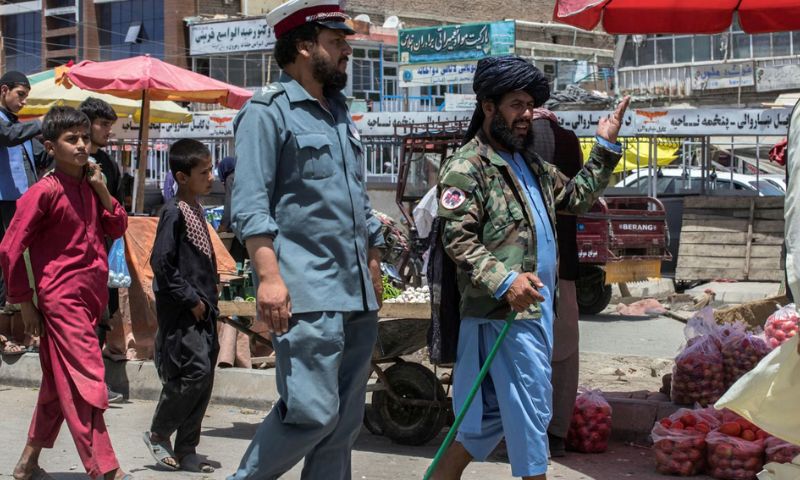
The tragedy extends beyond the 2021 collapse. SIGAR reports that the Taliban are now actively repurposing the remnants of the reconstruction effort and exploiting ongoing international aid to consolidate their authoritarian rule.
Critical infrastructure built with US funds lies unused, repurposed, or in disrepair. SIGAR inspected 90 US-funded civil infrastructure sites in late 2024 and found seven were “operational but not being used as intended,” including a pedestrian bridge used for vehicular traffic, a commercial facility turned into a soccer field, and government buildings housing Taliban security forces.
A $1 billion investment in establishing the Rule of Law has been erased by the Taliban’s draconian restrictions. More alarmingly, the Taliban’s governance model now directly threatens the integrity of humanitarian efforts aimed at alleviating a severe economic crisis.
SIGAR documents that “the Taliban interfered with food distribution, stealing food supplies, intimidating aid workers, and preventing female employees from working.” Most insidiously, the report finds that “since the fall of the Afghan government in August 2021, at least $10.9 million in US funds were used to pay taxes to the Taliban-controlled government” on humanitarian and development assistance.
“Without collecting comprehensive information on taxes and other payments made to Taliban-controlled governing institutions, the US government cannot fully assess the extent to which funding, intended for the Afghan people, was being directed to the Taliban,” SIGAR concludes.