


Key Points
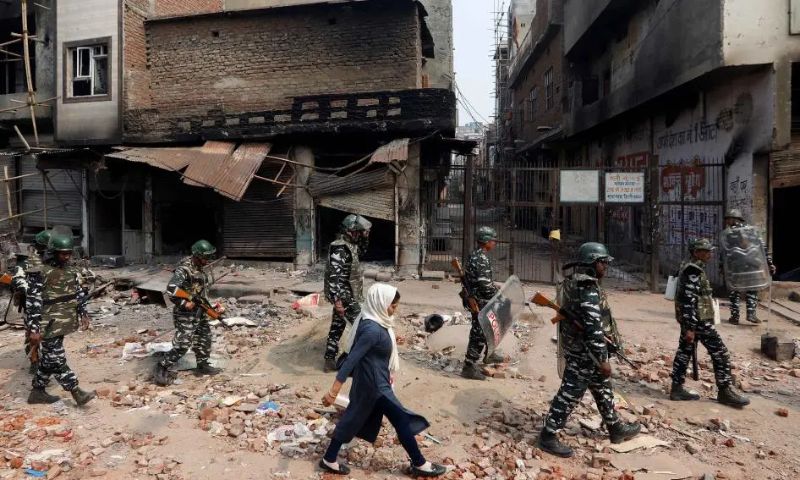
- Rising Attacks on Minorities: Since 2014, India has seen a significant increase in violence targeting Muslims and Christians, with anti-Christian incidents rising from 139 in 2014 to 834 in 2024.
- Christmas 2025 Flashpoints: During Christmas, mobs disrupted church services, vandalized displays, and assaulted individuals in multiple BJP-governed states, highlighting symbolic and widespread intolerance.
- Secularism under Strain: India’s constitutional secularism, once actively upheld, is increasingly questioned as authorities fail to condemn or prevent majoritarian violence against religious minorities.
NEW DELHI: India has witnessed a marked increase in violence and intimidation against religious minorities over the past decade, with recent Christmas-related incidents targeting Christian communities highlighting growing concerns about intolerance and the weakening of constitutional secularism under the current political climate.
According to a report published by The Wall Street Journal, India has witnessed a sharp rise in violence against religious minorities since Narendra Modi came to power in 2014, with attacks increasingly linked to groups aligned with his Hindu nationalist Bharatiya Janata Party.
India’s Muslims, who are 14% of the population, have borne the brunt of the most brutal physical attacks. They face active discrimination in employment, education, and housing, and are often prevented from voting and pursuing businesses in Hindu-majority areas.
They have been ghettoized. But as several ugly events in recent weeks have shown, Christians—a mere 2.3% of Indians, many of whom belong to the poorest sections of society—are also subjected to widespread hatred and thuggery, according to the report.

Although Hindus are 80% of India’s population, radical Hindus are obsessed with the imagined dangers of Christianity. As many as 12 states have laws prohibiting religious conversion by “force, fraud, or allurement”—the last term often defined as any form of evangelical persuasion.
Attacks on Christians are invariably justified as measures to stop conversions. Christmas has been a public holiday in India since independence, along with Hindu, Muslim, and Sikh holidays. Radical Hindu ideologues—including Yogi Adityanath, BJP chief minister of Uttar Pradesh, India’s most populous state—believe it shouldn’t be.
His government even ordered schools open on Christmas. Mobs of Hindus assembled outside churches in his state—at precisely the time of Christmas Eve services—and chanted “Death to Christian missionaries” while also screaming Hindu prayers aloud.
The report says that in recent days, almost every Indian with a cellphone has seen clips of a BJP leader in the state of Madhya Pradesh barge into a church, disrupt a Christmas feast, and assault a young blind woman, accusing her of abetting the conversion of Hindus to Christianity.
In Raipur, a city in the state of Chhattisgarh, Hindu chauvinists trashed Christmas displays at a mall, decapitating images of Santa Claus with iron rods. Incidents of this kind occurred in almost every Indian state governed by the BJP.
Citizens for Justice and Peace, an Indian human-rights group, keeps tabs on religious violence in the country, and says that this Christmas became “a national flashpoint for majoritarian assertion.” The attack on the mall, it says, was “not a spontaneous outburst.
It was symbolic violence—targeting Christmas imagery in a public commercial space to send a message: Christian visibility itself is unacceptable.” According to the United Christian Forum, a coalition of Indian Christian organizations, anti-Christian attacks rose from 139 in 2014 to 834 in 2024.
In 2025, as of November there were 706 recorded incidents. In its annual report for 2025, the U.S. Commission on International Religious Freedom recommended that the Trump administration designate India a “country of particular concern” for allowing “egregious religious freedom violations” to go unchecked and unpunished.
It cited examples of attacks that have occurred with impunity. In August 2024, “a Hindu mob of over 200 people attacked 18 Christian families in Chhattisgarh as police did not intervene.” Last December, eight village councils in that state passed a joint resolution requiring Christians to renounce their religion or leave.
This Christmas, Mr Modi made a show of attending Mass at the Cathedral Church of the Redemption in New Delhi. “The service reflected the timeless message of love, peace, and compassion,” he said. “May the spirit of Christmas inspire harmony and goodwill in our society.”
To Indian Christians, and to their many secular compatriots, those words were risible, as packs of Hindu activists ran riot against Christians in places far removed from New Delhi—places without the veneer of cosmopolitanism to which the Indian capital can only barely lay claim.
India’s secularism—enshrined in its constitution in 1950—has been flawed even in the best of times. It has always been skin-deep, grafted onto an instinctively sectarian population by the Western-educated elites who shepherded the country to independence from Britain.
But it was more than a hollow shibboleth in the years before Mr. Modi came to power. With unfortunate exceptions, governments made sincere efforts to curb the worst majoritarian excesses and ugliest assertions of Hindu chauvinism.
The report argues that under Narendra Modi, any remaining pretense of secularism has effectively collapsed. It notes that despite conciliatory remarks made by the prime minister after attending Christmas Mass, he has remained silent on attacks carried out by Hindu radicals against Christian communities.
While supporters contend that Modi cannot control every individual in a vast country, the report questions why he has not publicly condemned the violence or stated clearly that such actions are unacceptable in a civilised society, concluding that the implications of this silence are evident to any careful observer.