Key Points
- Khaleda Zia entered politics after the 1981 assassination of her husband, Ziaur Rahman, and took charge of a fractured BNP in 1984
- Emerged as the “uncompromising leader” against military ruler HM Ershad, enduring arrests and repression
- Remains the only Bangladeshi leader to have won every parliamentary seat she contested
- Leadership of the BNP now passes to her son, Tarique Rahman, expected to lead the party into the 2026 elections
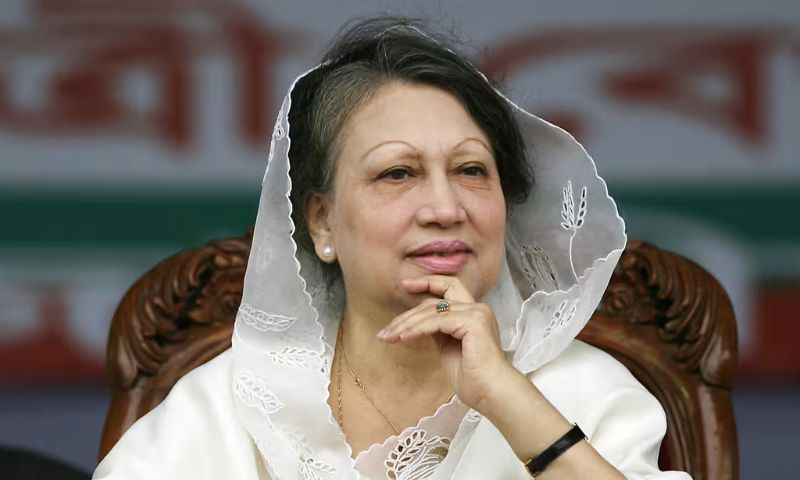
DHAKA: Khaleda Zia, Bangladesh’s former prime minister and one of the most consequential figures in the country’s political history, has died at the age of 80, closing the final chapter of a life that mirrored the turbulence, resilience and contradictions of the nation she helped shape.
Zia’s political journey was neither planned nor conventional. She emerged from the private sphere only after the assassination of her husband, President Ziaur Rahman, in 1981—an event that left the Bangladesh Nationalist Party (BNP) fractured and directionless.
Assumed leadership in 1984
With little formal political training and facing skepticism from senior party leaders, she assumed leadership in 1984 at a moment when the party was on the brink of collapse and the country was under the grip of military ruler Hussain Muhammad Ershad.
What followed was the transformation of a reluctant political figure into what supporters would later call the “uncompromising leader.”
Through repeated arrests, street agitations and an unyielding refusal to legitimize military rule, Khaleda Zia became the civilian face of resistance against authoritarianism in the 1980s.
Her resolve culminated in the 1991 general election, when she led the BNP to victory and became Bangladesh’s first female prime minister.
Defining moment of career
One of the most defining moments of her career came even earlier, in 1990, when she set aside a bitter rivalry with Sheikh Hasina to forge a joint movement against Ershad.
That rare political unity helped topple the military regime and paved the way for democratic restoration. As prime minister, Khaleda presided over the transition from a presidential to a parliamentary system—an institutional shift intended to safeguard democratic accountability.
Formed short lived parliament in 1996
Her second term was marked by another pivotal intervention in Bangladesh’s political architecture. Amid widespread unrest over electoral fairness, Khaleda formed a short-lived parliament in 1996 to pass the 13th constitutional amendment, institutionalising the caretaker government system.
She then dissolved parliament and resigned, contesting the subsequent election under the neutral authority she had helped create—an election her party lost, even as she personally won all the seats she contested. She remains the only Bangladeshi leader to have achieved that electoral distinction.
Economically, Khaleda Zia’s governments pursued liberalisation and revenue reform, notably introducing value-added tax (VAT) in 1991 and deregulating parts of the banking sector. Socially, her administration launched a landmark stipend programme for rural girls in 1994, making secondary education free and accelerating female participation in schooling—an initiative that reshaped Bangladesh’s social landscape.
Returned to power in 2001
In 2001, she returned to power with a landslide victory at the head of a four-party alliance, securing a two-thirds parliamentary majority. The win validated her controversial strategy of aligning with conservative Islamist parties, but it also deepened political polarization.
Her rivalry with Sheikh Hasina intensified, paralysing governance and eventually contributing to the breakdown of the democratic process in 2006–07, when an army-backed caretaker government intervened and jailed both leaders.
Khaleda Zia’s final decade in politics was defined by isolation and decline. In 2015, she was effectively confined to her party office during anti-government protests, where she received news of the death of her younger son, Arafat Rahman Koko.
Sentenced to prison in 2018
In 2018, she was sentenced to prison on corruption charges that her party and international observers widely viewed as politically motivated. For more than two years, she remained the sole inmate of the abandoned Old Dhaka Central Jail—an episode marked by severe isolation and worsening health.
Even after her conditional release in 2020, she remained confined to her home, largely absent from public life as the BNP was systematically weakened under Sheikh Hasina’s increasingly authoritarian rule. It appeared her political story would end in silence.
Fully freed in 2024
That silence was broken by history’s final twist. Following the mass student-led uprising in 2024 that toppled Hasina’s government, Khaleda Zia was fully freed.
She witnessed the collapse of the regime that had imprisoned her and the sentencing of her long-time rival in absentia. Yet, in a defining act of restraint, she refrained from triumphalism—urging national reconciliation and rejecting “politics of vengeance” in her first public address after years of enforced quiet.
Her health, however, continued to deteriorate. Battling heart and lung complications and reliant on a pacemaker, Khaleda Zia spent her final months in and out of hospital. She died in Dhaka, leaving behind a nation in transition and a party facing a critical leadership moment.
Tarique Rehman emerges as central figure
That mantle has now passed to her eldest son, Tarique Rahman. Long regarded as her political heir, Rahman has emerged as the central figure in Bangladesh’s opposition politics. After 17 years in exile, he returned to Bangladesh following the fall of the Hasina government, with multiple cases against him overturned.
As acting chairman of the BNP, Rahman is widely expected to lead the party into the February 2026 general elections and is seen as a likely prime ministerial candidate should the BNP win. Party leaders say he has already played a key role in reorganising the party and mobilising supporters, blending continuity with a generational shift.
With Khaleda Zia’s death, Bangladesh closes the chapter on a leader who walked out of domestic life to confront dictatorship, survived imprisonment and political erasure, and ultimately reclaimed her place in history.
The question now is whether her legacy—of resilience, compromise and confrontation—can be translated into electoral power by the son she leaves behind.