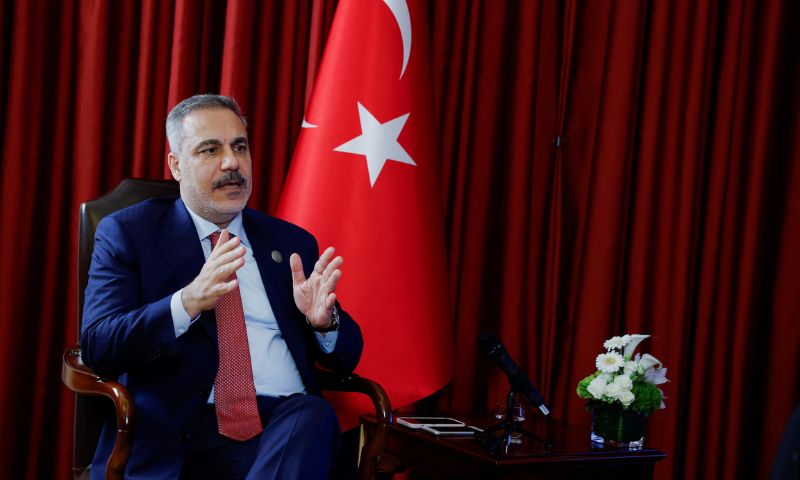



ANKARA, Turkiye: Turkish Foreign Minister Hakan Fidan met senior Hamas political bureau officials in Ankara to discuss the Gaza ceasefire and efforts to advance the agreement to its second phase, a Turkish Foreign Ministry source, cited by Reuters, said.
The source, cited by Reuters, said Hamas officials told Fidan they had fulfilled their obligations under the ceasefire agreement, but accused Israel of continuing military strikes in Gaza to prevent the deal from moving forward.
The Hamas delegation also said humanitarian aid entering Gaza remained insufficient. They said urgent supplies, including medicines, housing equipment and fuel, were still lacking, the source added.
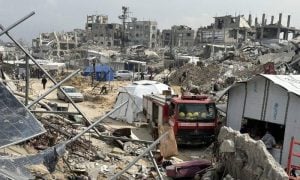
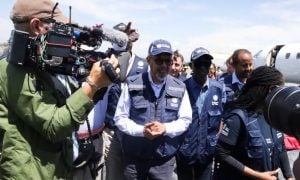
The talks came as the United Nations warned of worsening humanitarian conditions in the Palestinian territories.
The UN Office for the Coordination of Humanitarian Affairs (OCHA) said that over the past two weeks it had documented further incidents resulting in the killing and injury of Palestinians.
According to OCHA, six Palestinians were killed between December 9 and December 22, including five by Israeli forces and one by an illegal Israeli settler.
More than 100 Palestinians were displaced due to demolitions and evictions during the same period, including 63 in East Jerusalem and the remainder in Area C of the occupied West Bank.
Belgium joins genocide case against Israel
Meanwhile, Belgium on Tuesday formally joined a genocide case against Israel brought by South Africa at the International Court of Justice (ICJ). The Hague-based court said Brussels had filed a declaration of intervention.
Belgium said its move does not imply full support for South Africa’s accusations, nor does it amount to a defence of Israel.
It said it aims to clarify its interpretation of international law in the context of the case. Israel denies the genocide allegation.
Several countries, including Brazil, Colombia, Ireland, Mexico, Spain and Turkiye, have already joined the proceedings. South Africa filed the case in December 2023, accusing Israel’s Gaza offensive of breaching the 1948 Genocide Convention.
Israel unwilling to withdraw from Gaza
Political tensions have also been fuelled by conflicting statements from Israeli leaders on Gaza’s future.
Israeli Defence Minister Israel Katz on Tuesday denied any intention to resettle Gaza, following earlier remarks that suggested Israel could one day do so.
In remarks at an illegal settlement in the occupied West Bank, he said Israeli forces would remain in Gaza and pledged to establish military outposts in the north of the territory.
“We are deep inside Gaza, and we will never leave Gaza,” Katz said in comments reported by Israeli media.
Under a US-backed ceasefire framework agreed by Israel and Hamas in October, Israeli forces are expected to withdraw from Gaza.
Stabilisation force for Gaza
As Israel and Hamas edge towards talks on the second phase of the ceasefire, disagreements remain over the role of a proposed international stabilisation force.
Senior Hamas official Basem Naim, cited by Al Jazeera, said the group was ready to discuss “freezing or storing” weapons during the truce, but would not accept an international force tasked with disarming the group.
He said Hamas would welcome a United Nations force near Gaza’s borders to supervise the ceasefire and report violations, but not one with authority inside Palestinian territory.
Israeli Prime Minister Benjamin Netanyahu has said phase two of the plan would focus on ending Hamas governance in Gaza and achieving its disarmament. He described the next stage as “more difficult” than the first.
The initial phase has already faced strain. Israeli strikes have continued in Gaza during the truce, killing more than 370 Palestinians, according to local health officials. Israel has accused Hamas of delaying the release of captives.
Israeli military officials said forces have withdrawn behind a so-called “yellow line” but still control about 53 percent of Gaza.
Diplomatic efforts
Israel’s army chief, Lieutenant General Eyal Zamir, described the line as a “new border” and a forward defensive position.
Diplomatic efforts to advance phase two continued this week in Doha and Miami, where US officials met counterparts from Qatar, Egypt and Turkiye.
The talks focused on defining the mandate of the proposed international stabilisation force but failed to reach consensus.
US Secretary of State Marco Rubio said countries would not commit troops without clarity on legal authority, rules of engagement, funding and command structure.
He said Washington was grateful to Pakistan for offering to consider participation, but stressed that commitments would come only after a clear mandate is agreed.
Rubio said the United States plans to establish a “Board of Peace” and a Palestinian technocratic body to provide interim governance, which he described as essential for legitimising any international force.