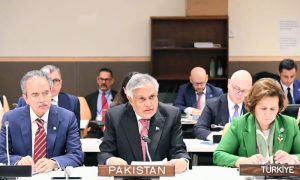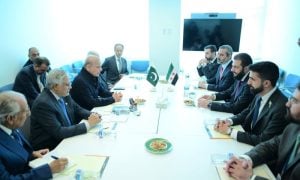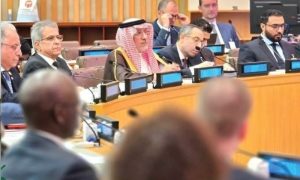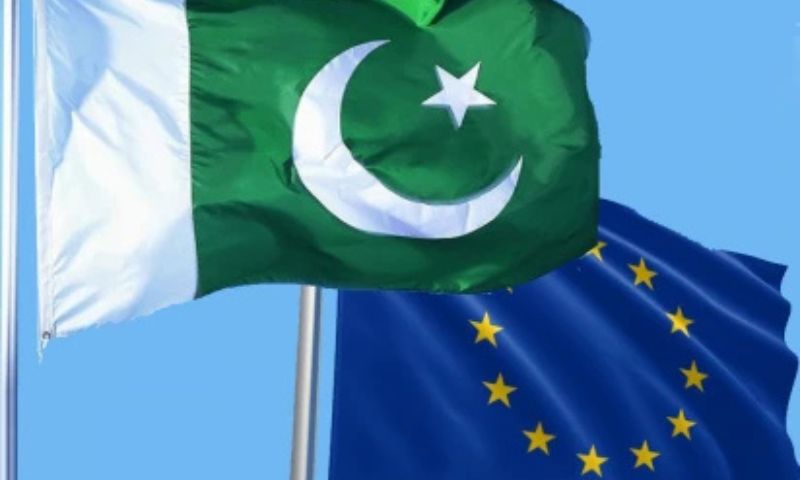
ISLAMABAD: Pakistan and the European Union discussed the situation in Afghanistan and security threats emanating from Afghan soil during the EU–Pakistan Joint Commission meeting held in Brussels, Pakistan’s Ministry of Foreign Affairs said on Saturday.
According to the Foreign Office statement, both sides exchanged views on the situation in Afghanistan and regional security challenges. Both sides underscored the importance of addressing humanitarian needs in the country.
On Friday, Pakistan demanded that the Afghan Taliban regime carry out a full investigation and take decisive action against the “perpetrators and facilitators” of terrorist attacks launched from Afghan territory.
Pakistan conveyed grave concern over the continued support and facilitation provided by the Afghan Taliban regime to the banned Tehrik-i-Taliban Pakistan (TTP) terrorist group, “enabling them to carry out terrorist attacks against the Pakistan military and civilian population” along the Pakistan-Afghanistan border and in adjoining areas.
Pakistan emphasised that the permissive environment enjoyed by the banned Tehrik-i-Taliban Pakistan in Afghanistan belies Afghanistan’s international commitments as well as to Pakistan, that it would not allow its soil to be used against any other country, including Pakistan, the spokesperson said.
Also Read: Pakistan Demands Afghan Taliban Act Against Terror Groups Operating from Afghan Soil
During the 15th meeting of the EU–Pakistan Joint Commission on 17 December, both sides reviewed political and economic developments in the EU and Pakistan. They also discussed in depth EU-Pakistan cooperation in the fields of democracy, governance, human rights, trade and investment, development, migration, climate and energy, science and technology, as well as the implementation of the EU-Pakistan Strategic Engagement Plan (SEP), the Ministry of Foreign Affairs said in a statement on Saturday.
Both sides exchanged views on the regional situation and reaffirmed the importance of their longstanding partnership, underpinned by shared interest in promoting regional stability, the statement read.
Progress on GSP+ framework
Both sides also reviewed Pakistan’s progress on the implementation of the 27 international conventions as required under the GSP+ framework. The EU welcomed progress made in bringing Pakistan’s application of the death penalty in line with international standards and encouraged further steps in this regard, the ministry stated.
The EU also recognised important first steps against torture, as well as the creation of a Commission on Minorities. The EU encouraged further steps to be taken in the short term in view of the upcoming GSP+ Monitoring Report, and reiterated the need for further reforms in the medium and long term.
EU, Pakistan bilateral trade
The EU is Pakistan’s second-largest trading partner, with Pakistan being the main beneficiary of the Generalised Scheme of Preferences Plus (GSP+) arrangement, contributing significantly to the growth of bilateral trade.
The meeting of the Sub-Group on Trade convened on 15 December 2025, where Pakistan side was represented by the Ministry of Commerce and the EU side by the European Commission’s Directorate-General of Trade.
During discussions, both sides acknowledged the importance of a robust multilateral trading system. EU-Pakistan bilateral trade relations were discussed at length, covering a wide range of topics, including market access challenges for both sides.
Among other areas of specific interest, cooperation on the implementation of the GSP+ was prominent. Both sides discussed follow-up of the GSP+ Monitoring Mission that took place from 24 November to 3 December 2025, including the upcoming GSP report and re-application to the GSP+ scheme under the new GSP Regulation.
Both sides highlighted the need to improve the overall business environment and expressed their commitment to advance this work, including at the upcoming High Level EU–Pakistan Business Forum on 28–29 April 2026 in Islamabad.
🔊PR No.3️⃣8️⃣1️⃣/2️⃣0️⃣2️⃣5️⃣
15th Meeting of the EU–Pakistan Joint Commission
🔗⬇️https://t.co/uBdjIdtd98 pic.twitter.com/yeYLOog1Ty
— Ministry of Foreign Affairs – Pakistan (@ForeignOfficePk) December 20, 2025
Development cooperation
The meeting of EU-Pakistan Sub-Group on Development Cooperation convened on 16 December 2025, Pakistan’s Ministry of Foreign Affairs stated. Pakistan was represented by the Joint Secretary of the Ministry of Economic Affairs, the EU by the Directorate-General for International Partnerships of the European Commission.
The EU and Pakistan agreed on the continued relevance of key priority areas under the ongoing Multiannual Indicative Programme (MIP): i) green inclusive growth, ii) human capital/TVET, and iii) governance, including rule of law and human rights.
Pakistan welcomed the EU’s continuous support to Pakistan’s climate change resilience, in a Team Europe approach. The EU presented the outline of the projects for the period 2025-2027 and updated on the EU’s policy framework and Global Gateway strategy. In particular, the EU and Pakistan welcomed the recent re-engagement of the European Investment Bank On the margins of the Joint Commission, the European Investment Bank (EIB) signed its first credit financing agreement in Pakistan’s water sector since 2015.
The EU welcomes the ongoing discussions between Pakistan and UNHCR to seek to identify and compile a list of vulnerable cases, to ensure their adequate protection. The EU appreciated that Pakistan is hosting millions of Afghan nationals for over four decades. They emphasised that any return must be safe, dignified and in line with international standards.
Collaboration on security challenges
The EU and Pakistan recognised the significance of regional collaboration on security challenges, particularly in the areas of counterterrorism and counter-narcotics. The EU underlined the continuous relevance of its Strategy for Cooperation in the Indo-Pacific in steering its engagement in the region.
Both sides affirmed their support to the implementation of the Comprehensive Plan to end the Gaza Conflict, which allowed for a ceasefire, the release of the hostages and better humanitarian access to Gaza.
They reiterated the importance of ensuring that all parties adhere to the ceasefire, implement all phases, and refrain from any actions that jeopardise the agreement. The EU stressed its determination to contribute to the implementation of the Plan by contributing to security, governance, recovery and reconstruction aspects. They underscored their support for concrete steps towards the two-state solution in accordance with the relevant UN resolutions.
Indus Waters Treaty
During the meeting, the Pakistan side briefed on the issue of Jammu and Kashmir, as well as on the Indus Waters Treaty.
Both sides stressed the importance of resolving conflicts peacefully and in full conformity with international law and the principles of the UN Charter. The two sides also discussed the situation in Afghanistan, security threats emanating from Afghan soil and the need for humanitarian assistance.