
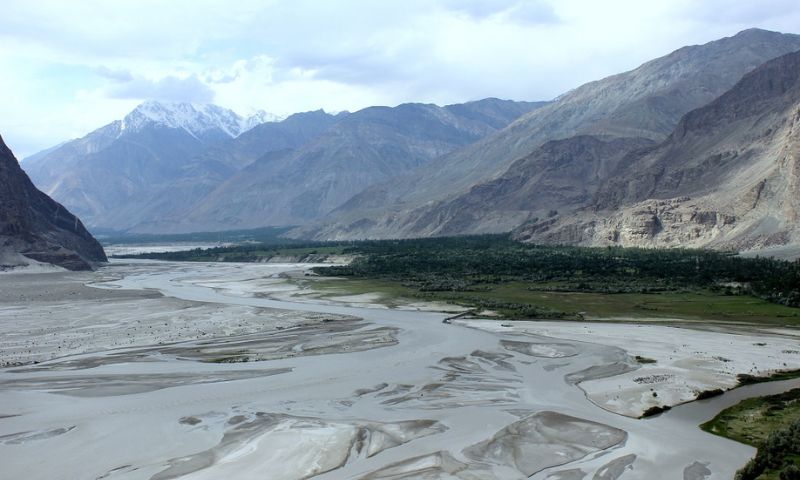



ISLAMABAD: Claims circulating in sections of the media that water flows from India into Pakistan through the Rivers Jhelum, Neelum and Chenab have fallen to low levels are “false and misleading”, Pakistan Commissioner for Indus Waters said on Friday.
The Commissioner for Indus Waters rejected the media reports, saying the changes being observed are routine seasonal variations and do not indicate any abnormal reduction in river inflows. The commissioner said that the media reports about the reduction in water flows into Pakistan are “completely false and misleading”.
Deliberate misinformation
Some media outlets reported that water flows into Pakistan via the Jhelum, Neelum and Chenab rivers had dropped to low levels, raising concerns about potential water shortages and violations of the Indus Waters Treaty (IWT).
The reports claimed an unusual reduction in flows and implied possible upstream interference.
What the authorities say
The Pakistan Indus Water Commissioner has categorically rejected these claims. According to the Commissioner, the Indus Waters Commission has not issued any warning regarding the reduction in water flow in these three rivers.
Indus Water Commissioner Pakistan has confirmed that the Commission has not even issued a warning in this case, which is one of their initial steps during seasonal inflow variation. “The changes being observed are only seasonal inflow variations,” the commission stated.
Why this misinformation?
On Friday, the UN experts’ report observed that India’s decision to hold the Indus Waters Treaty (IWT) in “abeyance” following the Pahalgam incident “may be taken to disrupt the flow of water to Pakistan under the Indus Waters Treaty”.
The UN report stated that New Delhi’s actions appeared to risk violating the rights to work and livelihood, an adequate standard of living — including the rights to water and food — a clean, healthy and sustainable environment and development.
On the day that the UN has vindicated Pakistan’s stance on the Indus Waters Treaty (IWT), according to Pakistani authorities, this is a deliberate misleading media feed to create confusion and anxiety.
Currently, the water flows in these three rivers are near to normal winter levels commensurate with this time of year, the Commission stated.
Officials noted that in any case, Pakistan needs to increase its water storage capacity during the monsoon season, as 25 to 30 million acre-feet of water is discharged into the Arabian Sea within three months each year, to offset natural winter reductions and climatic changes.
Violations of right to work and livelihood
The UN experts who compiled the report observed that New Delhi’s actions that “may be taken to disrupt the flow of water to Pakistan under the Indus Waters Treaty” appeared to risk violating the rights to work and livelihood, an adequate standard of living — including the rights to water and food — a clean, healthy and sustainable environment and development.
For its part, Pakistan termed any attempt to suspend its water share under the treaty an “act of war”, noting the treaty had no provision for unilateral suspension.
Under the 1960 Indus Waters Treaty, three rivers that flow westwards — Indus, Chenab and Jhelum — were awarded to Pakistan, with India getting three eastern-flowing rivers of the Indus Basin.
Stabilisation of water flows
Official monitoring of the Chenab River flow at Marala (excluding Jamu and Manawar Tawi) is being conducted by the Punjab Irrigation Department.
The monitored data is shared by the Irrigation Department with the office of the Pakistan Commissioner for Indus Waters. The data so received indicates that the discharge of the Chemab River (mainstem) has stabilised following a significant period of volatility.
Hydrological records from the first half of December 2025 confirm that an extraordinary reduction in flows was observed, persisting from December 10 to December 16, 2025.
During this window, the river flow frequently dropped and the lowest flow observed was 870 cusecs, which was significantly below the historical 10-year minimum range of approximately 4,018 to 4,406 cusecs for those dates.
In order to assess the reason for the extraordinary reduction in flows of Chenab Main at Marala, a significant reduction in the surface area of Baglihar has been observed on satellite imagery of 8 December 2025, which was increased as per the imagery of 13 December 2025.
This reduction, followed by an increase in the surface area of the Baglihar reservoir, leads to the belief that India has emptied the Baglihar reservoir, followed by its refilling. It is clarified that, according to the Indus Waters Treaty, India cannot empty the dead storage of the reservoirs of the run-of-river hydroelectric plants developed on the Western Rivers.
Pakistan’s Commissioner for Indus Waters has taken up the matter with the Indian Commissioner for Indus Waters and asked for the details/data relating to the extraordinary reduction in flows of the Chenab River, under the framework of the Indus Waters Treaty.
Improvement and recovery
A positive shift in river hydrology began on December 17, 2025, as the river flow began to rise steadily. On December 17, the flow reached 6,399 cusecs, effectively entering the historical ten-year range for the first time since the mid-month decline.
Punjab Irrigation Department data indicate that as of December 19, 2025, the river flows are presently within the last ten-year range of maximum to minimum flows. For instance, recent readings on the 19th show flows of 4,505 cusecs and 6,494 cusecs, which align with or exceed historical expectations for this time of year.
‘Abeyance’ of Indus Waters Treaty
Discussing the “abeyance” of the Indus Waters Treaty by India in a unilateral action, the UN experts highlighted its significance for Pakistan.
They noted that rivers irrigate 18 million hectares of farmland in the country (about 80 percent of Pakistan’s arable land), particularly in the food bowl provinces of Punjab and Sindh, contributing 24 percent of Pakistan’s gross domestic product.
“The rivers are thus vital in providing food security and livelihoods within Pakistan’s population of 240 million people. Limited water storage in Pakistan means that it relies on the unimpeded flow of river water.
“Any disruption of the flow of water under the Indus Waters Treaty (such as by filling large pondage pools and reservoirs, opening dam gates to flood downstream, or the mass release of sediment) could have serious impacts onistan, human rights in Pak including the right to work and livelihood, the right to an adequate standard of living (including the right to water and the right to food), the right to a clean, healthy and sustainable environment and the right to development,” they said.
The experts further stated that Pakistan was “already a water-stressed country and is one of the ten countries most vulnerable to the adverse effects of climate change, including water scarcity”.
They said they were “deeply concerned” that any disruption of the flow of water to Pakistan, a consequence of India holding the IWT in “abeyance” could “severely affect the human rights of millions of people […] who rely on the river for agriculture, industry, drinking water and sanitation and healthy ecosystems”.