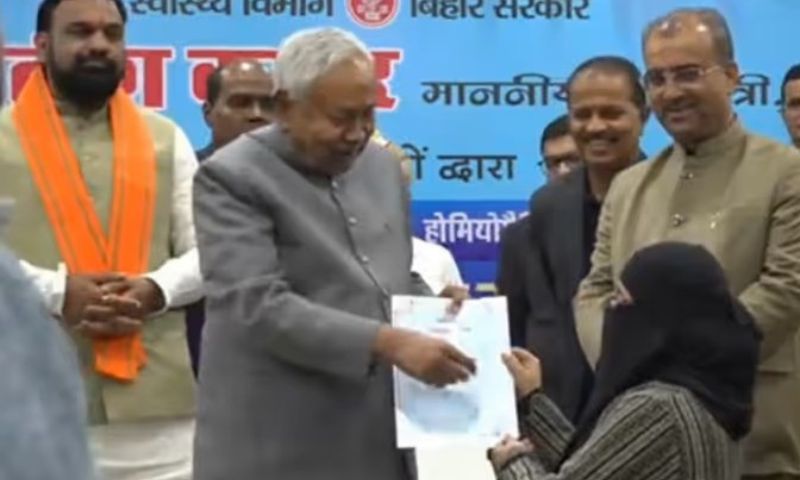



PATNA, India: India’s Bihar state Chief Minister Nitish Kumar on Monday forcibly removed the hijab of a woman doctor during a public function in Patna, drawing strong criticism and concerns over minorities rights situation in the country.
A video surfaced on social media showing CM Kumar forcibly removing the hijab of a woman doctor. The incident has sparked public outrage and raised concerns over minority rights and women’s safety in India.
At a government event at the CM’s secretariat in Patna, Kumar, who recently assumed office for the 10th time, was distributing appointment letters to doctors.
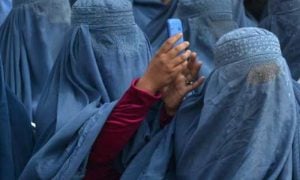
Video footage shows the 74-year-old chief minister instructing Nusrat Parveen to remove her hijab before physically pulling it down, exposing her mouth and chin. Deputy Chief Minister Samrat Choudhary is seen attempting to intervene.
There is no way Nitish Kumar is this vile to do something like this.
He has totally lost control of his senses and must step down from his post.
This is difficult to even watch.
— Roshan Rai (@RoshanKrRaii) December 15, 2025
Indian opposition political party, Congress, called the act “vile” and demanded Kumar’s resignation. “A female doctor had come to collect her appointment letter, and Nitish Kumar pulled off her hijab. A man occupying the highest position in Bihar is openly indulging in such a vile act. How safe will women in the state be?” the party wrote on X.
The Rashtriya Janata Dal (RJD) spokesperson Ejaz Ahmad said the incident reflected the attitude of the JD(U)-BJP alliance toward women and minorities. “By removing the hijab from the face of a Muslim woman who observes purdah, he has made it clear what kind of politics the JD(U) and BJP are engaging in,” Ahmad said.
यह क्या हो गया है नीतीश जी को?
मानसिक स्थिति बिल्कुल ही अब दयनीय स्थिति में पहुंच चुकी है या नीतीश बाबू अब 100% संघी हो चुके हैं?@yadavtejashwi #RJD #bihar #TejashwiYadav pic.twitter.com/vRyqUaKhwm— Rashtriya Janata Dal (@RJDforIndia) December 15, 2025
Minority rights abuses
The hijab incident occurred amid growing concerns about attacks on religious minorities in India.
A joint study by the Association for Protection of Civil Rights and the Quill Foundation documented 947 hate-related incidents between June 2024 and June 2025, including 602 hate crimes and 345 instances of hate speech.
Muslims were the primary targets, accounting for 1,460 victims across 419 incidents, according to the study. Christians suffered 85 attacks but had a higher victim count of 1,504 individuals.
The study found that only 13 percent of these incidents led to formal police complaints. Many attacks reportedly involved political party affiliates.
The researchers said attacks ranged from mob violence over cow slaughter rumours to harassment during festivals and interfaith relationships.
“The low rate of FIRs and the involvement of political actors embolden attackers,” the study concluded.
Human Rights Watch’s 2024 World Report also documented systematic discrimination and harassment of minorities under the BJP-led government.
Meenakshi Ganguly, HRW’s deputy Asia director, said the government’s policies had “led to increased violence against minorities, creating a pervasive environment of fear and a chilling effect on government critics.”
The report highlighted the use of politically motivated criminal charges, including terrorism, to target activists, journalists, and opposition figures.
Communal violence
Several incidents in 2025 underscore ongoing minority rights challenges. In Nuh district, Haryana, communal violence erupted during a Hindu procession, spreading to neighbouring areas.
Authorities reportedly retaliated against Muslim residents by demolishing homes and detaining men and boys.
In Manipur, northeastern India, violence between the majority Meitei and minority Kuki communities left over 200 dead and tens of thousands displaced.
Other cases include restrictions on free expression and assembly in illegally-occupied Jammu and Kashmir, extrajudicial killings, and delayed justice for female athletes reporting sexual abuse by a BJP parliamentarian.