


Amid shifting regional alignments, Pakistan’s leadership is signalling a deliberate move toward alternative frameworks for South Asian cooperation—frameworks that do not centre India and do not depend on SAARC’s stagnated structures.
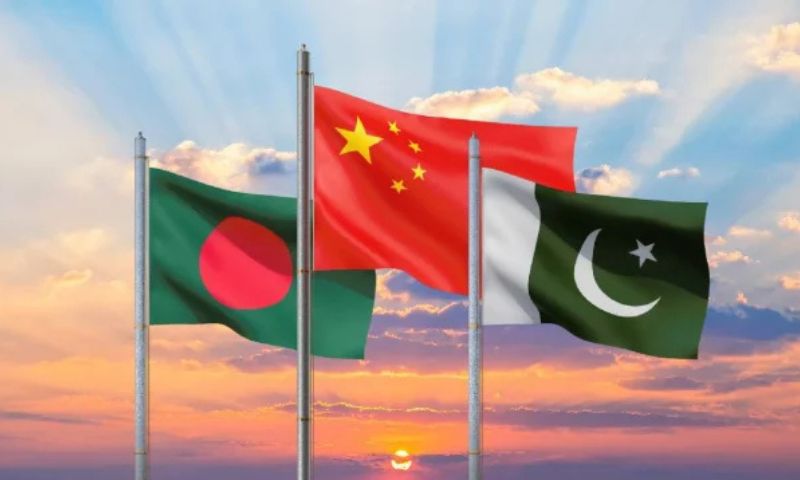
Earlier this month, Pakistan’s Deputy Prime Minister Ishaq Dar said the recent trilateral initiative between Pakistan, China, and Bangladesh could be expanded to include additional regional countries, suggesting that a new bloc is increasingly conceivable at a time when SAARC has become largely ineffective due to India-Pakistan tensions.
Speaking in Islamabad, he stressed cooperation over confrontation and argued that regional ties should not be limited by zero-sum thinking. The trilateral talks in June focused on development and stability. They were “not directed at any third party.” Still, Dar’s comments come amid worsening South Asian politics—Pakistan’s rivalry with India, a brief air conflict earlier in the year, and deteriorating Bangladesh-India relations after Sheikh Hasina’s ouster and India’s refusal to return her for trial.
For more than a decade, India’s ability to stall the South Asian Association for Regional Cooperation (SAARC) effectively paralyzed any meaningful regional integration. Islamabad’s latest move directly challenges that status quo.
According to Dar, the new arrangement offers “variable geometry” groupings on economy, technology, and connectivity—allowing flexible coalitions to operate without Indian participation.
The message is explicit: South Asia will not be held hostage to what Islamabad calls “rigidity.”
Pakistan now openly says SAARC has become ineffective because of India
In a message marking the 40th anniversary of the SAARC Charter, Prime Minister Shehbaz Sharif reflected on why the organization has struggled to deliver on its founding vision. The goals of SAARC, he said, have remained largely unrealized due to “political considerations” within the region—an unmistakable reference to India’s role in stalling cooperation.
President Asif Ali Zardari was even more explicit. In his own Charter Day message, he recalled that the 19th summit was planned for Islamabad in 2016 but was blocked after India refused to attend, leaving SAARC “stalled” for more than a decade. New Delhi’s approach, he argued, has become “the central impediment to meaningful regional cooperation,” forcing member states to re-examine whether South Asia can afford continued paralysis. Zardari pointed to growing interest in a revived regional arrangement that keeps the door open for all, but does not allow one state to halt collective progress, and even suggested that Iran and China could be integrated into a broader regional architecture.
Kunming Was the Beginning
The idea was initially floated earlier this year when the three states met in Kunming, China. At the time, New Delhi dismissed the meeting as symbolic. Today, it appears Kunming was the starting point of a carefully crafted architecture that touches on trade, maritime cooperation, climate, health and digital infrastructure, key sectors in which China has already consolidated influence across the wider Asian region.
Now, Pakistan says expansion is “officially on the table.”
Beijing has repeatedly spoken of a “Greater South Asia” involving Iran, Afghanistan, Myanmar and other SAARC members. Pakistan’s foreign policy establishment increasingly echoes this vision, positioning Islamabad, not New Delhi, as the pivot in emerging regional connectivity corridors from the Arabian Sea to the Bay of Bengal.
Pakistan’s New Strategic Self-Definition
This shift also aligns with Islamabad’s evolving security doctrine, which now describes Pakistan as a “net stabilizer” in the region—suggesting a more assertive posture and willingness to respond diplomatically and economically to Indian pressure. For decades, Pakistan was portrayed as reactive. The new messaging reframes Islamabad as a driver and moderator of regional stability, particularly in the context of India’s tense relations with Bangladesh and other neighbours.
New Delhi’s discomfort has been visible, and the irony is stark. India spent a decade attempting to isolate Pakistan and to build alternative platforms such as BIMSTEC.
Today, BIMSTEC itself appears stalled, while a Pakistan-China-Bangladesh core has emerged with the ambition—and capability—to expand.
Toward an Asia-Led, India-Free Regional Order
The most striking element of Dar’s announcement is that it was delivered openly, officially and early this month—not through unnamed sources. That alone marks a foreign-policy shift: Islamabad is no longer reluctant to articulate a vision of South Asia where India is neither central nor indispensable.
If this new framework continues to expand, India may find itself confronting a regional order that has moved on, one in which Pakistan is positioned not on the periphery, but at the core of a wider Asian connectivity network. South Asia is reorganizing. And for the first time since the Cold War, Pakistan believes it has the strategic momentum to shape what that reorganization looks like.