Key points
- PM Shehbaz Sharif offers Kyrgyzstan access to Pakistan’s ports to boost regional and global trade.
- Leaders commit to raising bilateral trade from US$15–16 million to US$200 million within two years.
- Institutional mechanisms and inter-governmental commissions agreed on follow-up and implementation.
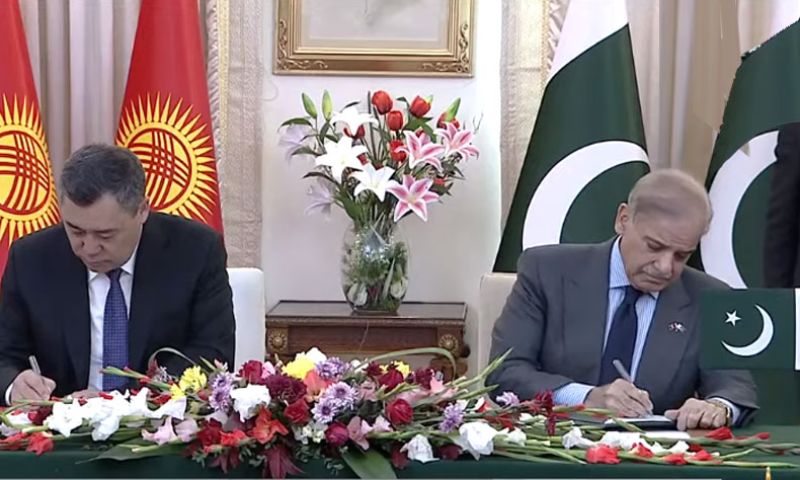
ISLAMABAD: President Sadyr Zhaparov of Kyrgyzstan and Prime Minister Muhammad Shehbaz Sharif presided over a landmark signing ceremony at the Prime Minister’s House on the second day of Zhaparov’s historic visit.
The visit was the first by a Kyrgyz head of state in twenty years that sealed 15 memoranda of understanding (MoUs) to enhance cooperation in trade, energy, connectivity, and other strategic sectors.
The agreements, described as a “framework for structured, result-oriented engagement,” cover commerce, foreign service and diplomatic academies, agriculture, health, mining, tourism, customs data exchange, and prisoner transfer protocols. A symbolic pact also designates Islamabad and Bishkek as “sister cities,” reinforcing long-term bilateral ties.
In a joint statement, both leaders reaffirmed their commitment to comprehensive cooperation. PM Shehbaz Sharif emphasised that Pakistan is ready to provide Kyrgyzstan, a landlocked country, with access to Karachi, Gwadar, and Port Qasim, facilitating export-import operations and regional trade.
The leaders set an ambitious target to raise bilateral trade from current levels of US$15–16 million to US$200 million within two years, leveraging port access and the upcoming Pakistan-Kyrgyzstan Business Forum to galvanise private-sector engagement.
Beyond commerce, the cooperation agenda spans energy, agriculture, defence, education, culture, and people-to-people exchanges, reflecting a multi-faceted partnership.
Officials also agreed to institutionalise regular political consultations and convene a Bilateral Inter-Governmental Commission to monitor and implement the agreements, ensuring that today’s commitments translate into concrete outcomes. Regional initiatives, including the CASA-1000 energy project and trade connectivity, were highlighted as strategic priorities.
With the MoUs now in place and institutional mechanisms set up for follow-up, analysts see today’s visit as a potential turning point in Pakistan-Kyrgyz relations. Pak-Kyrgyz ties could offer Pakistan greater reach into Central Asia and Kyrgyzstan access to maritime trade routes, while setting the stage for expanded economic and diplomatic cooperation in the region.