
Key points
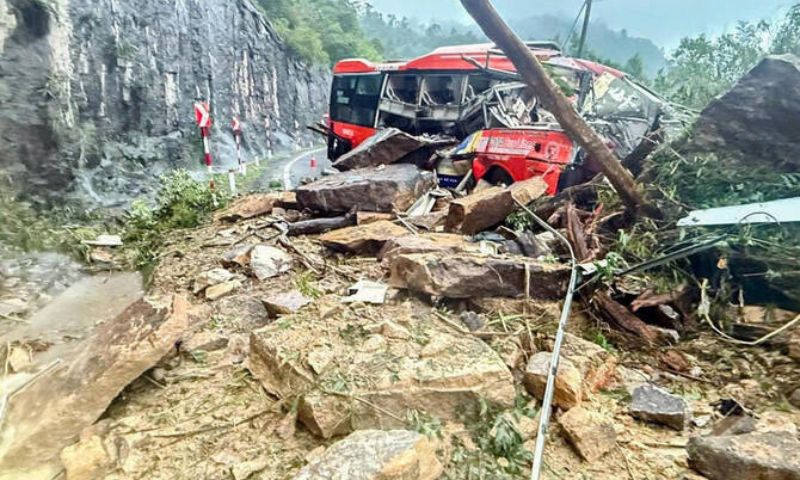
- Bus crushed by landslide kills six passengers.
- Flooding strands over 800 train passengers Monday.
- Industrial Park inundated, forcing factory power shutdowns.
- Landslides isolate villages and collapse key bridge.
- Scientists warn climate change intensifies Vietnam’s disasters.
HANOI: Torrential rains pounded central Vietnam on Monday, unleashing landslides and floods that killed at least seven people, injured dozens, and left thousands stranded across multiple provinces. The region, already reeling from record rainfall and Typhoon Kalmaegi weeks earlier, is now facing renewed devastation as authorities brace for more downpours through Wednesday.
Meteorologists warn that rainfall in parts of central Vietnam may reach 30–60 centimeters (12–24 inches), with some locations expected to exceed 85 centimeters (33 inches).
Khanh Hoa province, among the hardest-hit areas, recorded some of its heaviest rainfall in years on Sunday night. A massive landslide struck a passenger bus traveling through the mountainous Khanh Le pass at around 9:30 p.m., crushing the vehicle’s front section and killing six people, reports Arab News.
The bus, carrying 32 passengers from Ho Chi Minh City and traveling from Da Lat to the coastal city of Nha Trang, became trapped between landslides on both sides of the road. Rescue teams were unable to reach the site until after midnight due to blocked access, state media reported. Several injured passengers were transported to a nearby hospital, while two bodies remained pinned beneath debris as hazardous conditions slowed recovery efforts.
“I was thrown onto the roof of the bus before falling down,” said 39-year-old conductor Nguyen Long Cuong, describing the moment the landslide struck.
The 33-kilometer (20-mile) Khanh Le pass, known for its scenic views, is notoriously prone to landslides during the rainy season.
More Landslides Hit Central Highlands as Workers Buried
Heavy rainfall triggered landslides across key transport routes in the Central Highlands, forcing authorities to suspend traffic on multiple steep passes. In another incident in Khanh Hoa, waterlogged soil collapsed onto 10 workers at the Khanh Son pass on Sunday night, killing one and injuring another. One worker remained missing, while seven others managed to escape to safety.
Flooding also inundated the port city of Cam Ranh and the coastal district of Cam Lam late Sunday, submerging more than 100 meters (328 feet) of railway track. Over 800 passengers aboard four trains were stranded as water and debris made the lines impassable.
At the Du Long Industrial Park, home to factories operated by German and South Korean firms, floodwaters reached one meter (3.2 feet), forcing power cuts and halting operations for thousands of workers.
In Dak Lak province, police closed sections of the national highway after floodwaters made conditions unsafe.
In Hue, landslides blocked a major north–south highway, isolating several mountain communities and leaving thousands cut off. In Quang Ngai province, rainfall of 150–235 millimeters (5.9–9.3 inches) collapsed a bridge over a stream, stranding 1,200 residents in remote hamlets.
A tornado also struck parts of Danang and Quang Ngai on Sunday night, ripping roofs off homes, uprooting trees, and scattering debris.
Vietnam remains among the world’s most flood-prone nations, with nearly half its population exposed to high-risk areas. Scientists warn that climate change is intensifying storms and rainfall across Southeast Asia, making extreme weather events — and their destructive impacts — increasingly frequent.