


KEY POINTS
- Trump administration imposes 25% tariffs on Canadian and Mexican imports
- US raises tariffs on Chinese imports to 20%
- Mexico announces countermeasures against US
- China imposes up to 15% tariffs on US agricultural goods and restricts exports to American firms
- Canada enforces 25% tariffs on US goods, warns of further measures
- Global stock markets decline, with auto and financial stocks hit hardest
- China rejects US allegations as a pretext for trade war
- Tariffs expected to raise prices for US consumers
- Trump warns of additional tariffs against any country retaliating against US trade policies
OTTAWA: China, Mexico, and Canada on Tuesday announced retaliatory measures against the United States after President Donald Trump’s sweeping tariffs came into force at midnight US time, despite warnings that the move could escalate into a full-blown trade war.
The US has imposed tariffs of 25 per cent on imports from Canada and Mexico—its two largest trading partners—and raised tariffs on Chinese goods to 20 per cent, doubling the levy introduced last month.
The tariffs are set to impact more than $918 billion (£722 billion) worth of imports from Canada and Mexico alone.
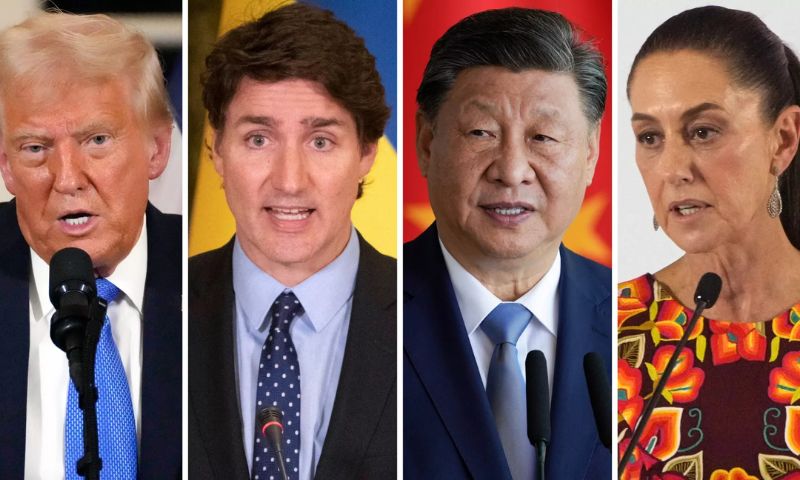
Mexico’s President Claudia Sheinbaum condemned the tariffs as unjustified and accused Washington of making “offensive and defamatory” claims about her government.
The White House had alleged that Mexico had “afforded safe havens for the cartels,” a claim Sheinbaum rejected outright.
“There is no reason or justification for these tariffs,” she stated during her morning press conference on Tuesday.
“The unilateral decision taken by the United States affects national and foreign companies that operate in our country and impacts our people. Therefore, we have decided to respond with tariff and non-tariff measures,” she added, noting that further details would be announced soon.
China imposes fresh tariffs
Beijing has also retaliated by introducing fresh tariffs on a range of agricultural imports from the US.
China’s Ministry of Finance announced that additional 15 per cent tariffs would be imposed on chicken, wheat, corn, and cotton, while a 10 per cent levy would apply to sorghum, soybeans, pork, beef, aquatic products, fruits, vegetables, and dairy items.
China’s foreign ministry spokesperson, Lin Jian, warned that Beijing would not bow to pressure. “China will fight till the end if the US insists on waging a tariff war, trade war, or any other kind of war,” he said at a press briefing.
Separately, China’s Ministry of Commerce has added 15 American companies to its export control list, barring Chinese firms from exporting dual-use equipment to them.
The Chinese government has also announced the suspension of lumber imports from the US and an anti-dumping investigation into American fibre optic products.
Canada responds with tariffs on US goods
Canadian Prime Minister Justin Trudeau announced immediate countermeasures, including 25 per cent tariffs on C$30 billion ($20.7 billion) worth of US imports.
Additional tariffs covering another C$125 billion ($86.2 billion) of US goods will be introduced if the US tariffs remain in place beyond 21 days.
“Tariffs will disrupt an incredibly successful trading relationship,” Trudeau stated. “This move violates the US-Mexico-Canada free trade agreement signed by President Trump during his first term.”
ALSO READ: EU Warns US Tariffs on Canada, Mexico Threaten Economic Stability
Ontario Premier Doug Ford has also signalled a potential energy retaliation. “If they want to try to annihilate Ontario, I will do everything, including cut off their energy, with a smile on my face,” Ford told reporters on Monday, adding that the eastern US heavily relies on Canadian energy supplies.
Markets and economic repercussions
Global markets reacted negatively to the tariffs. The Nikkei in Japan fell 1.6 per cent, Taiwan’s TWII index dropped 0.5 per cent, and Hong Kong’s Hang Seng declined by 0.3 per cent.
In Europe, London’s FTSE 100 fell 0.65 per cent, France’s CAC 40 dropped 0.9 per cent, and Spain’s Ibex was down 0.8 per cent.
The Canadian dollar and Mexican peso hit their lowest levels in a month, reflecting investor concern over the escalating trade dispute.
Automotive stocks took a sharp hit, with Germany’s Volkswagen dropping nearly 4 per cent and Stellantis—maker of Chrysler and Jeep—falling almost 7 per cent.
US justifies tariffs
The Trump administration has defended its decision, claiming that the tariffs are necessary to combat the flow of fentanyl into the US.
“While President Trump gave both Canada and Mexico ample opportunity to curb the dangerous cartel activity and influx of lethal drugs flowing into our country, they have failed to adequately address the situation,” the White House said in a statement.
ALSO READ: Trade Wars Escalate as US Tariffs on Canada, Mexico, and China Take Effect
However, China has rejected these allegations as a “pretext” to justify economic aggression. China’s State Council Information Office issued a document outlining Beijing’s efforts to control fentanyl-related substances, accusing Washington of “finger-pointing and buck-passing.”
Economic fallout
The tariffs are expected to increase prices for American consumers on a wide range of goods, including fresh produce, vehicles, electronics, and home appliances.
The Peterson Institute for International Economics estimates that the additional tariffs could cost the average US household more than $1,200 annually, making it “the largest tax increase in at least a generation.”
Despite Trump’s insistence that foreign exporters bear the cost of tariffs, economic experts highlight that it is US importers who must pay, and businesses often pass these costs onto consumers through higher prices.
Trump has warned of further measures, threatening reciprocal tariffs against countries that impose duties on US-made goods, with additional tariffs expected to take effect as soon as next month.