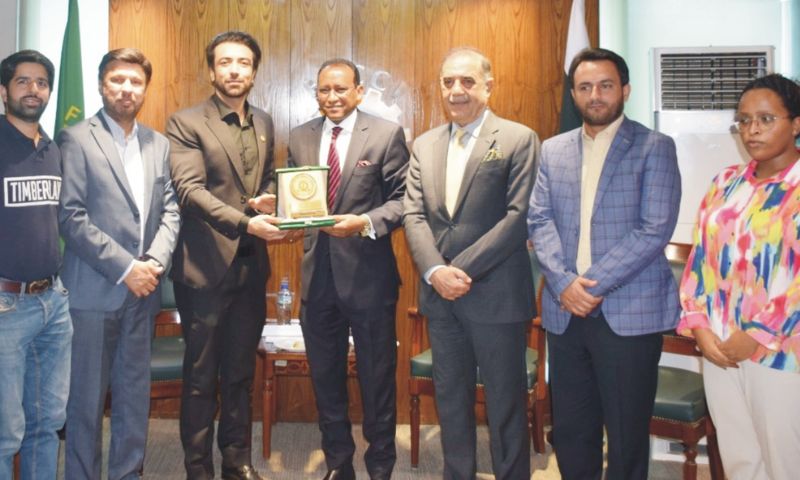
ISLAMABAD: Ethiopian Ambassador to Pakistan Jemal Beker Abdula visited the Federation of Pakistan Chambers of Commerce & Industry (FPCCI) Capital Office in Islamabad and called on Vice President FPCCI Umar Masood ur Reham, Convenor, Syed Asad Mashadi.
They discussed wide-ranging trade, industry, and commercial avenues of cooperation, investments, and joint ventures, On behalf of the business and trading community. Mr. Jamal Beker Abdula, Ethiopian ambassador, said that a preferential trade agreement between Pakistan and Ethiopia is indispensable for the promotion of mutual trade.
“Bilateral trade between the two countries is minimal and amounts (only) to $78 million; however, my target is to take it to $300 million by the end of 2023. Pakistani textiles, medicines, and other products will have more space in the Ethiopian market.
The Ethiopian Ambassador, Mr. Jamal Beker Abdula, noted that the world should not see Pakistan through the lens of the Western media. Pakistan is a peaceful, culturally rich and diversified country with extremely strong social values and huge economic potential, he noted.
He stressed the bilateral trade relations, and stated that Ethiopia is an attractive market for Pakistani agricultural, pharmaceutical, and technological products while Ethiopia is critical to Pakistan’s food security in terms of the importation of red kidney beans, chickpeas, and pulses. He urged businessmen in Pakistan to look into Ethiopia’s potentially profitable markets.
According to Abdullah, Pakistan has a lot of chances to expand exports to Africa and Ethiopia wants to forge strong commercial relationships. “Pakistan’s business community must try to fully capitalise on the opportunities as Pakistani textiles, pharmaceuticals, and other products are in great demand in Ethiopia.” He claimed that the Ethiopian market will have more room for Pakistani goods including textiles, medications, and other goods.
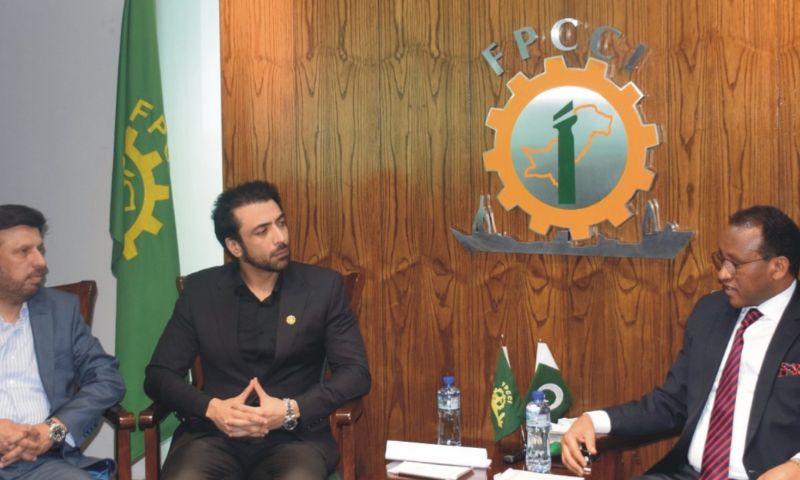
He said that confidence-building measures would be taken for Pakistani traders so that trade between the two countries could go to the next level.
on the occasion, Vice President FPCCI Umar Masood ur Rehman said that Pakistan and Ethiopia should sign a preferential trade agreement to improve mutual trade adding that the agreement will significantly improve bilateral trade. He said that Pakistan has made a Look Africa Policy to explore huge untapped region of Africa for trade and exports and close cooperation between Pakistan and Ethiopia would helpful in getting better access to African market.
He said many Pakistani products including marble and granite, pharmaceuticals, cement, leather, rice and sporting goods can find a good market in Ethiopia and urged Ethiopia to focus on imports from Pakistan.
In order to expand trade relations to their full potential, he advised Pakistan and Ethiopia to consider working out a preferential or free trade agreement.
He said the two countries should promote regular exchange of trade delegations to explore all potential areas of mutual cooperation.
He further said that FPCCI would like to work closely with the Ethiopian Embassy to promote business relations between Pakistan and Ethiopia.
The FPCCI Vice President said that the real potential for bilateral trade is much higher in Pakistan and Ethiopia. He proposed a preferential agreement or free trade agreement to promote trade relations to their true potential. Many Pakistani products including marble and granite, pharmaceuticals, cement, leather, rice and sporting goods can find a good market in Ethiopia and urged Ethiopia to focus on imports from Pakistan.
He said investment cooperation is another area where the two countries could work together for mutual benefit. Bilateral trade between the two brotherly countries can be increased manifold. Pakistan is a large potential market and economic and trade relations are in the interest of both countries. He said that frequent exchange of trade delegations is an option that can bring the people of both countries closer which would ultimately strengthen the mutual cooperation between Pakistan and Ethiopia.