


KEY POINTS
- India’s PSLV-C62 rocket failed during space mission, causing the loss of 16 satellites.
- Unsuccessful launch marked second consecutive PSLV failure, following a similar failure in May 2025.
- The mission carried Indian military satellite EOS-N1 and multiple foreign payloads.
- Satellites from Brazil, Nepal, the UK and Spain were among those lost.
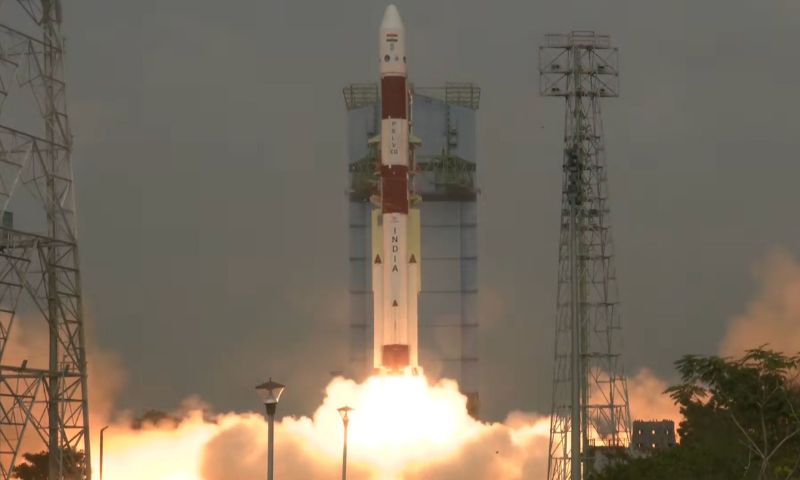
NEW DELHI: India’s Polar Satellite Launch Vehicle (PSLV) has suffered a second consecutive mission failure as the Indian Space Research Organisation (ISRO) said on Monday that an anomaly during the rocket’s third stage prevented the deployment of 16 satellites into orbit.
The PSLV-C62 rocket lifted off from the Satish Dhawan Space Centre on India’s east coast on Sunday, January 11, carrying Indian and foreign payloads. The mission marked the rocket’s return to flight after its previous launch in May 2025 ended in failure.
According to India Today, PSLV-C62 mission failed during the third stage of launch, resulting in the loss of 16 satellites in space.
This failure is not just an isolated accident but a continuation of growing weaknesses in India’s space programme, according to analysts cited by Indian media.
The Indian space agency IRSO said the launch encountered a technical problem near the end of the third-stage burn.
As a result, the vehicle deviated from its intended flight path and the satellites could not be placed into their designated orbits.
“The PSLV-C62 mission encountered an anomaly during the end of the PS3 stage. A detailed analysis has been initiated,” ISRO said in a brief statement posted on X.
The PSLV-C62 mission encountered an anomaly during end of the PS3 stage. A detailed analysis has been initiated.
— ISRO (@isro) January 12, 2026
ISRO Chairman V. Narayanan, quoted by India Today, said the initial phases of the launch were normal.
“While the initial flight stages were nominal, the third stage failed to provide the required thrust due to an unexpected drop in chamber pressure,” Narayanan said.
“We observed a significant deviation from the intended flight path, and as a result, the satellites could not be placed in orbit,” the IRSO Chairman said.
He added that engineers were analysing flight data and would provide further updates.
Second failure in succession
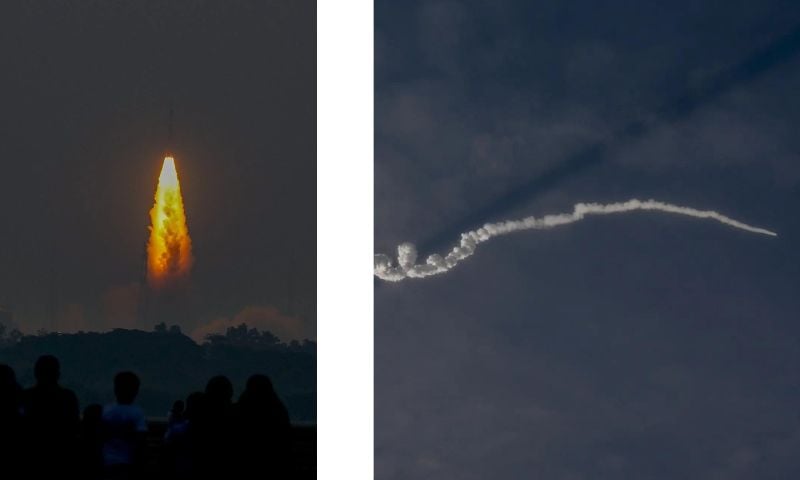
The PSLV-C62 failure follows the unsuccessful PSLV-C61 mission on May 18, 2025, which also suffered a malfunction during its third-stage burn.
That earlier anomaly led to the loss of ISRO’s EOS-09 Earth-observation satellite.
The latest incident is the fourth failure for the PSLV rocket since its debut in 1993, out of 64 total launches.
According to Indian analysts, the failure of the PSLV-C62 rocket has confirmed that India’s space technology, including its missile programme, is unsafe.
Indian media outlets have exposed the weaknesses of India’s space programme and missile technology.
According to analysts, the technology used in the failed rocket is also linked to India’s Agni missile programme, creating serious concerns.
Analysts are raising questions about Indian technology, warning that if the same flaw appears in India’s strategic missiles during a wartime situation, the consequences would be severe.
Military and international payloads lost
The primary payload on board PSLV-C62 was EOS-N1, also known as Anvesha, a small Earth-observation satellite intended for India’s military.
Indian media outlet, The Tribune, has described EOS-N1 as a hyperspectral imaging satellite designed to collect intelligence data across hundreds of wavelengths.
“The satellite was meant to constantly scan the Earth’s surface and provide valuable intelligence,” The Tribune reported, adding that it was part of India’s expanding fleet of military surveillance satellites.
Alongside EOS-N1, the rocket was carrying 15 additional payloads, including several from foreign customers.
According to mission manifests, these included satellites from Brazil, Nepal, the United Kingdom and Spain.
Foreign payloads included Aldebaran-1, AllToSpace, EduSat, Galaxy Explorer, Orbital Temple and UaiSat from Brazil; Munal, a Nepali student satellite; a UK Earth-observation satellite identified as Theos-2; and the Kestrel Initial Technology Demonstrator (KID), a Spanish re-entry capsule developed by startup Orbital Paradigm.
The KID capsule was intended to separate during the later phase of the mission and re-enter Earth’s atmosphere for a controlled splashdown in the South Pacific.
All payloads were destined for low Earth orbit, except the re-entry capsule.
Return-to-flight mission
Sunday’s launch was organised by NewSpace India Limited, ISRO’s commercial arm. The PSLV had not flown since the May 2025 failure.
During the webcast, Narayanan noted unusual behaviour near the end of the third stage.
“Close to the end of the third stage engine burn, we saw a disturbance in the vehicle roll rates, followed by a deviation in the flight path,” he said.
The ISRO stated that a detailed technical investigation is under way into the mission failure.
Analysts raise questions
The back-to-back failures have prompted debate within Indian media and strategic community.
Analysts quoted by Indian outlets have noted that space launch vehicle technology is closely linked to missile systems, arguing that repeated anomalies raise broader questions about reliability.
ISRO has not commented on such assessments and has limited its public statements to the technical aspects of the PSLV-C62 mission.
ISRO officials say findings from the ongoing investigation will determine corrective measures before the PSLV’s next flight.