
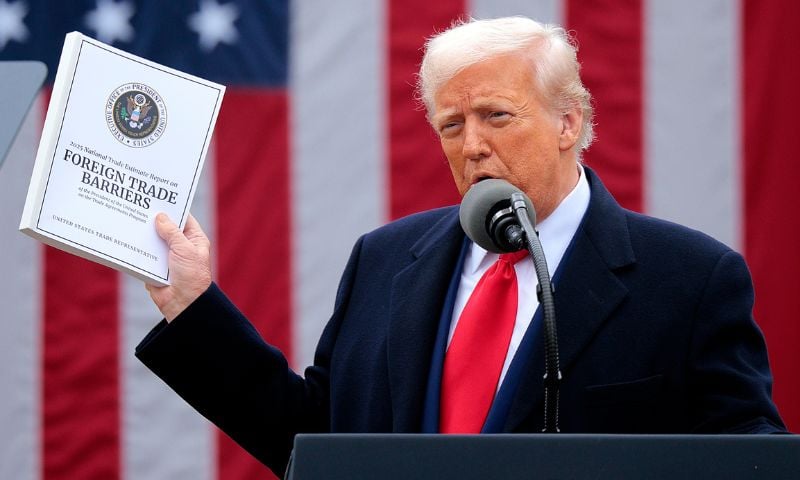



WASHINGTON: The US Supreme Court on Friday struck down President Donald Trump’s broad tariffs imposed under the International Emergency Economic Powers Act, ruling that his use of the law was unlawful.
The 6-3 decision, authored by Chief Justice John Roberts, rejected one of Trump’s most significant claims of executive power and carries major consequences for the global economy.
Roberts wrote that Trump overstepped his authority by using the 1977 law to justify the tariffs.
Citing previous Supreme Court precedent, he stated that the president must show clear approval from Congress for such an extraordinary use of power, and in this case, he could not.
The court upheld a lower court ruling against the Republican president’s actions.
Trump has made tariffs a central tool of his economic and foreign policy, sparking a global trade war after beginning his second term.
These import taxes have strained relationships with trading partners, shaken financial markets, and created widespread economic uncertainty.
The case reached the Supreme Court after businesses affected by the tariffs and a group of 12 mostly Democratic-led states challenged Trump’s unprecedented use of the International Emergency Economic Powers Act (IEEPA) to impose the taxes without congressional approval.
The tariffs were expected to raise trillions of dollars for the US over the next decade.
While the Trump administration has not released the data since mid-December, economists at the Penn-Wharton Budget Model estimated Friday that IEEPA-based tariffs had generated over $175 billion.
With the court’s ruling, that amount may now need to be refunded.
Congress authority to impose taxes and tariffs
The US Constitution grants Congress, not the president, the power to impose taxes and tariffs.
Trump bypassed this by invoking IEEPA, which allows a president to regulate commerce during a national emergency, to place tariffs on nearly all US trading partners.
Some additional tariffs imposed under other laws are not affected by this ruling and represent about one-third of the revenue from Trump’s total tariffs, based on government data from October to mid-December.
Trump was the first president to use IEEPA for tariffs, part of a broader pattern of testing executive authority since returning to office.
His actions have ranged from immigration enforcement and firing federal officials to domestic military deployments and overseas operations.
Trump defended the tariffs as essential for US economic security, warning that without them the country would be defenseless and exploited by other nations.
He pointed to long-standing trade abuses by countries like China as justification.
Following Supreme Court arguments in November, Trump acknowledged the possibility of an unfavorable ruling and said he would develop a backup plan.
Treasury Secretary Scott Bessent and other officials indicated they would seek alternative legal grounds to preserve as many tariffs as possible.
Options include using a provision allowing tariffs on imports that threaten national security or another permitting retaliatory measures against countries found to use unfair trade practices.
However, these alternatives lack the flexibility and immediate impact of IEEPA and may not replicate the full scope of Trump’s tariffs quickly.
The Congressional Budget Office estimated that if all current tariffs, including those under IEEPA, remained in place, they would generate about $300 billion annually over the next decade.
US customs duty receipts reached a record $195 billion in fiscal 2025, according to Treasury data.
In April 2025, Trump announced what he called reciprocal tariffs on most US trading partners, invoking IEEPA to address a national emergency over trade deficits, despite the country having run such deficits for decades.
Earlier that year, he imposed tariffs on China, Canada, and Mexico, citing the flow of fentanyl and illicit drugs into the US as an emergency.
Trump has used tariffs to extract concessions, renegotiate trade deals, and pressure countries on non-trade issues, including Brazil’s treatment of former President Jair Bolsonaro, India’s oil purchases from Russia, and a Canadian ad campaign critical of US tariffs.
IEEPA was enacted in 1977 under Democratic President Jimmy Carter and included stricter limits on presidential power than the law it replaced.
The Supreme Court’s ruling consolidated three lawsuits. The US Court of Appeals for the Federal Circuit had ruled in favor of five small businesses in one case and a group of 12 states in another.