
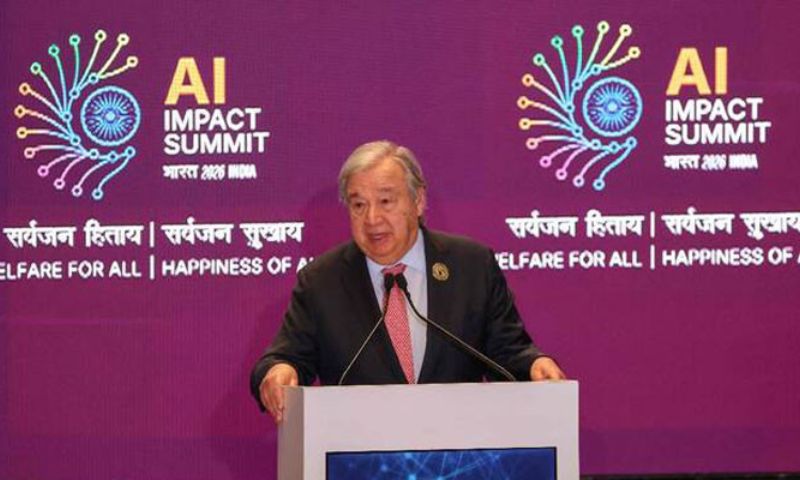



NEW DELHI, India: The United Nations has announced a new panel on artificial intelligence aimed at making “human control a technical reality,” UN Secretary-General Antonio Guterres said Friday, as world leaders gathered at the AI Impact Summit in New Delhi to shape the global conversation on the future of this transformative yet divisive technology.
Highlighting the dual nature of the AI boom, Guterres noted the risks of job disruption, online abuse, and the heavy electricity consumption of data centres. “We are barrelling into the unknown,” he said. “The message is simple: Less hype, less fear. More facts and evidence.”
According to AFP, the United Nations General Assembly has confirmed 40 members for the newly created Independent International Scientific Panel on Artificial Intelligence, an advisory body designed to be to AI what the UN’s Intergovernmental Panel on Climate Change (IPCC) is to global warming.
“Science-led governance is not a brake on progress,” Guterres added, emphasizing that it can make technological development “safer, fairer, and more widely shared.” He stressed that understanding what AI systems can and cannot do is key to moving from rough measures to smarter, risk-based guardrails.
Dozens of world leaders and ministers are expected to articulate a shared perspective on AI’s risks and opportunities by the conclusion of the five-day summit. This is the fourth annual global AI policy meeting, with the next scheduled for Geneva in the first half of 2027, according to the Swiss president.
The Delhi summit marks the first AI gathering hosted by a developing country, allowing India to showcase its ambitions to compete with the United States and China. The country anticipates more than $200 billion in AI-related investments over the next two years, with major US tech firms unveiling new deals and infrastructure projects during the week.
Focus on the “Common Good”
OpenAI CEO Sam Altman, whose company powers ChatGPT, spoke about the need for oversight, warning that centralization of AI in a single company or country could be risky.
“This is not to suggest that we won’t need any regulation or safeguards. We obviously do, urgently, like we have for other powerful technologies,” he said.
While prior summits in France, South Korea, and Britain produced broad statements, the Delhi event’s outcomes may remain largely aspirational.
“Governance of powerful technologies typically begins with shared language: what risks matter, what thresholds are unacceptable,” said Niki Iliadis, director of global AI governance at The Future Society. She added that while AI companies are influential, they are not sovereign.
The summit, attended by tens of thousands from the AI industry, covered major topics ranging from child protections to ensuring equitable access to AI tools worldwide. Indian Prime Minister Narendra Modi emphasized the global importance of responsible AI use.
“We are entering an era where humans and intelligence systems co-create, co-work and co-evolve,” he said. “We must resolve that AI is used for the global common good.”
In a significant development, India formally joined the US-led “Pax Silica” initiative aimed at strengthening AI supply chains. “It’s about building supply chains that will not be held hostage,” said Jacob Helberg, US Under Secretary of State for Economic Affairs.