
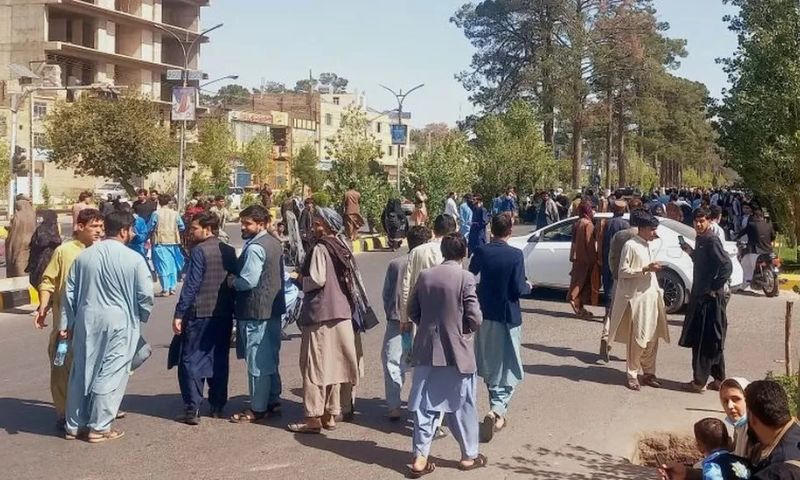



ISLAMABAD: A strong earthquake struck eastern Afghanistan on Friday, shaking buildings in the capital Kabul and sending tremors across the border into north-western Pakistan, officials and witnesses said.
The 5.8-magnitude quake hit about 130 kilometres northeast of Kabul, the United States Geological Survey (USGS) said. There were no immediate reports of casualties or major damage.
The tremor was felt Kabul and in Nangarhar province, AFP reported. Residents in Bamiyan and Wardak provinces, west of the capital, also reported shaking.
Tremors during Iftar in Pakistan
The earthquake was also felt in several districts of Pakistan’s Khyber Pakhtunkhwa province, including Peshawar, Malakand, Lower Dir, Charsadda, Mardan, Swabi, Parachinar, Nowshera and Abbottabad, according to local residents.
The tremor struck during Iftar, as families were breaking their Ramadan fast.
Buildings shook and utensils rattled, prompting people to rush out of homes and offices into open spaces.
In Peshawar and surrounding areas, residents gathered in streets and courtyards, checking on neighbours and reciting prayers.
Similar scenes were reported in parts of Khyber district and Charsadda.
Residents described the shaking as strong and lasting several seconds.
Authorities in Pakistan said there were no immediate reports of casualties or property damage.
Seismic activity in Hindu Kush
Earthquakes are common in Afghanistan, particularly along the Hindu Kush mountain range, where the Eurasian and Indian tectonic plates meet.
The country has suffered a series of deadly quakes in recent years.
In August 2025, a shallow 6.0-magnitude earthquake in eastern Afghanistan destroyed mountainside villages and killed more than 2,200 people.
Weeks later, a 6.3-magnitude tremor in northern Afghanistan killed at least 27 people.
Large earthquakes in western Herat province near the Iranian border in 2023, and in Nangarhar province in 2022, killed hundreds and destroyed thousands of homes.
Afghanistan’s predominantly rural population lives largely in mud-brick houses that are vulnerable to seismic shocks.
Decades of conflict have weakened infrastructure and limited the country’s capacity to respond to disasters.
Poor communications and mountainous terrain have hampered rescue operations in the past, with authorities sometimes taking hours or days to reach remote villages to assess damage.