


RIYADH, Saudi Arabia: As Saudi Arabia advances toward the goals of Vision 2030, the Kingdom is making artificial intelligence (AI) a central pillar of its education reform strategy.
By embedding AI across the national curriculum, policymakers aim to equip over 6 million general education students with future-ready skills.
To achieve this, government bodies and private sector leaders have aligned efforts to integrate AI education into classrooms nationwide, according to Arab News.
A collaborative initiative launched in 2025 brings together the National Centre for Curriculum, the Ministry of Education, the Ministry of Communications and Information Technology, and the Saudi Data and Artificial Intelligence Authority (SDAIA).
The initiative focuses not only on teaching students to use AI tools but also on enabling them to learn through AI-driven platforms, with teachers playing a central role in the transformation.
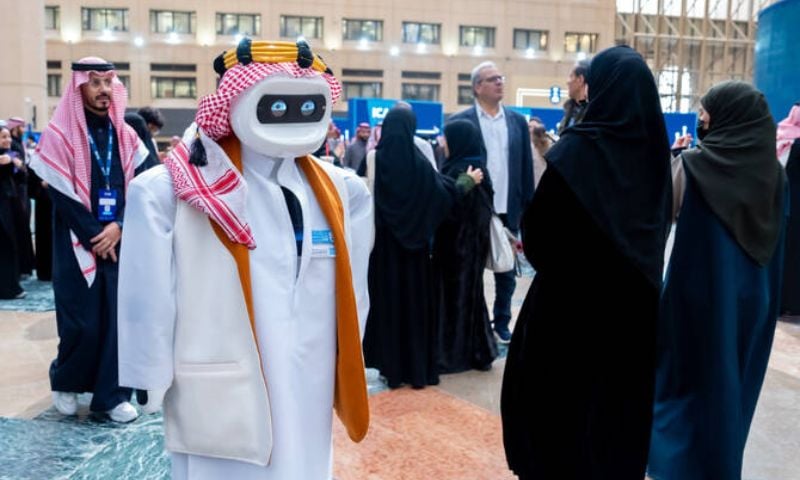
At the International Conference on Data and AI Capacity Building organized by SDAIA, participating entities outlined progress and future ambitions, underscoring Saudi Arabia’s drive to become a global hub for AI-enabled education.
Bedour Alrayes, deputy CEO of the Human Capability Development Program under Vision 2030, emphasized the importance of integrating AI systematically into learning pathways. “It’s not about how they learn AI, it’s about how they practice it,” Alrayes told Arab News.
She described a structured model starting in elementary school. “When we talk about K-12, we start by enabling digital curriculum from the fourth grade, also AI curriculum in schools.
We enable teachers to know how to use AI tools, and we have gamification tools where they use AI, including after-school activities and customized learning journeys,” she said.
Alrayes stressed a balance between technological advancement and human engagement, describing the approach as a “human-centric partnership” between people and AI.
The strategy spans the full education continuum – from K-12 to university – and extends into lifelong learning and professional development, ensuring Saudi citizens remain competitive in a rapidly evolving global economy.
SDAIA has also introduced the Saudi Academic Framework for AI Qualifications, a national benchmark guiding the development, evaluation, and accreditation of AI programs in higher education.
This framework has attracted international technology firms keen to contribute to the Kingdom’s transformation.
Justina Nixon-Saintil, IBM’s vice president and chief impact officer, highlighted growing demand for AI capabilities in the local market.
“We launched our AI skilling programs just a few years ago, and as of last year we had already skilled 500,000 people,” she told Arab News.
“What I love is that there’s such demand here. People are eager to learn, eager to grow and eager to take advantage of AI skills.
It’s also because it’s being led by the government, corporations, and universities; everyone is aligned with Vision 2030 and wants to ensure their citizens are ready to seize these opportunities.”
IBM collaborates with leading institutions including King Saud University and Princess Nourah University, delivering AI education and certification programs to faculty and students.
Nixon-Saintil underscored the necessity of coordination between industry and academia. “We do not implement any programs without input from the private sector.
When we look at training pathways and hands-on projects, we partner with the private sector to understand what skills they’re looking for and how jobs are evolving, because they are changing very quickly,” she said. IBM aims to equip 1 million Saudis with AI skills by 2030.
Private sector innovators are also contributing to classroom transformation. Alex West, founder and CEO of Manifest XR, described how the company’s AI-powered tools help educators create dynamic learning content.
“The AI tools we provide can produce content for teachers based on simple text prompts.
They can upload documentation and create videos, assessments, quizzes, and an entire course for students to learn from. We provide structured training programs on safely introducing AI technology and issue certificates for teachers,” he said.
West emphasized the urgency of narrowing the gap between workforce demands and educational adaptation.
“Educators, if they want to stay ahead and remain competitive, should be introducing this technology so students can be prepared for industry placements and the 2030 vision.
In the next few years, things are going to look even more different. The Kingdom wants this technology everywhere and wants to improve learning quality. We allow this to scale not only for high-end international schools but in any school, even in resource-deprived areas.”
Anees Ahmad, regional manager at Spectrum Networks, echoed this commitment to nationwide transformation.
“As part of Vision 2030, we are here to cater to all government, semi-government, and enterprise customers in fulfilling the requirements of the transformation,” he told Arab News.
More than 30,000 people attended the International Conference on Data and AI Capacity Building last month at King Saud University, reflecting the scale of Saudi Arabia’s ambition to integrate AI throughout its education system.