








NEW DELHI: India’s relationship with Israel has grown increasingly close under Prime Minister Narendra Modi, with the war in Gaza appearing to accelerate a shift in New Delhi’s approach to the conflict, according to analysts cited by Al Jazeera.
The change has become particularly visible as several Western countries have increased pressure on Israel over its military campaign in Gaza and settlement expansion in the occupied West Bank.
In September 2025, Israeli Finance Minister Bezalel Smotrich visited India, where he held meetings and travelled to New Delhi, Mumbai and Gujarat, Modi’s home state.
The visit came amid growing international criticism of Smotrich over his statements on Palestinians and the occupied West Bank.
The trip highlighted India’s willingness to expand economic engagement with Israel even as the war in Gaza continued.
Modi Deepens Ties
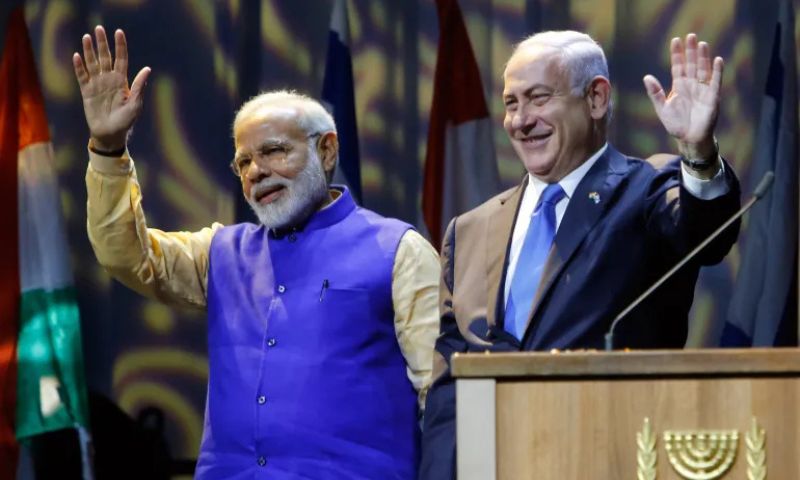
Modi visited Israel in February 2026, meeting Israeli Prime Minister Benjamin Netanyahu as Israel faced mounting diplomatic pressure over the war.
During the visit, Netanyahu described Modi as “a great friend of Israel” and “a brother”, underlining the close relationship between the two leaders.
India’s shift towards Israel predates the Gaza war, however. Relations developed gradually after diplomatic ties were established in 1992, but expanded significantly under Modi, who became the first Indian prime minister to visit Israel in 2017.
Former Indian diplomat Navdeep Suri told Al Jazeera that the relationship, once largely kept out of public view, had become much more open under Modi. He cited defence cooperation, intelligence sharing and shared security concerns as key factors behind the partnership.
Gaza Changes The Debate
India’s response to the Hamas-led attacks on Israel on 7 October 2023 marked a significant moment in its public position. Modi swiftly condemned the attacks, expressing shock and describing them as terrorist attacks.
During his 2026 visit to Israel, Modi reiterated his stand on the Hamas-led attacks on Israel and called them terrorism.
Analysts say the framing of Israel as a country confronting terrorism has helped strengthen support for closer ties within Modi’s political camp.
Rasheed Kidwai, a political analyst in New Delhi, told Al Jazeera that the relationship also reflects domestic political narratives in India, where the ruling Bharatiya Janata Party (BJP) has promoted a Hindu nationalist agenda.
He said sections of India’s Hindu right admire Israel’s security policies, while the relationship also serves practical interests, particularly in defence and intelligence.
India has become a major buyer of Israeli military equipment. Investigations by Al Jazeera and other media outlets have also reported Indian arms exports to Israel during the Gaza war.
Growing International Pressure
Several Western countries have taken measures against Israeli officials and settlement-related activities as criticism of the war has intensified. These measures have included sanctions on individuals and restrictions affecting products from Israeli settlements in the occupied West Bank.
India, by contrast, has continued to call for a two-state solution and humanitarian access while avoiding stronger public criticism of Israel.
Suri said New Delhi should take more principled positions on the conflict, including on violence in Gaza and attacks by Israeli settlers in the West Bank.
He attributed India’s reluctance to criticise Israel partly to close political ties between the two governments.
The war has also raised questions about the balance between India’s traditional support for Palestinian statehood and its growing strategic partnership with Israel.
A Historic Policy Shift
India opposed Israel’s creation in 1948 and supported the Palestinian cause for decades, reflecting its anti-colonial foreign policy and diplomatic ties with Arab countries.
New Delhi backed a 1975 United Nations General Assembly resolution that described Zionism as a form of racism. India also established early relations with the Palestine Liberation Organisation and recognised Palestinian statehood before establishing formal diplomatic ties with Israel in 1992.
Successive Indian governments gradually expanded relations with Israel, but Modi has made the partnership more prominent.
Kidwai told Al Jazeera that Modi’s political approach differs from that of previous governments, which viewed support for Palestine as an important part of India’s foreign policy and domestic political landscape.
The growing closeness between New Delhi and Tel Aviv suggests that defence, intelligence and political alignment are increasingly shaping India’s approach to the Middle East, even as the humanitarian toll of the Gaza war continues to draw international condemnation.