


KEY POINTS
- 53 people were killed in February 2020 violence linked to citizenship protests
- Key accused in “larger conspiracy” remains in extended pre-trial detention under anti-terror law
- Bail proceedings marked by adjournments and stringent statutory thresholds
- Allegations of selective prosecution fuel minority rights concerns
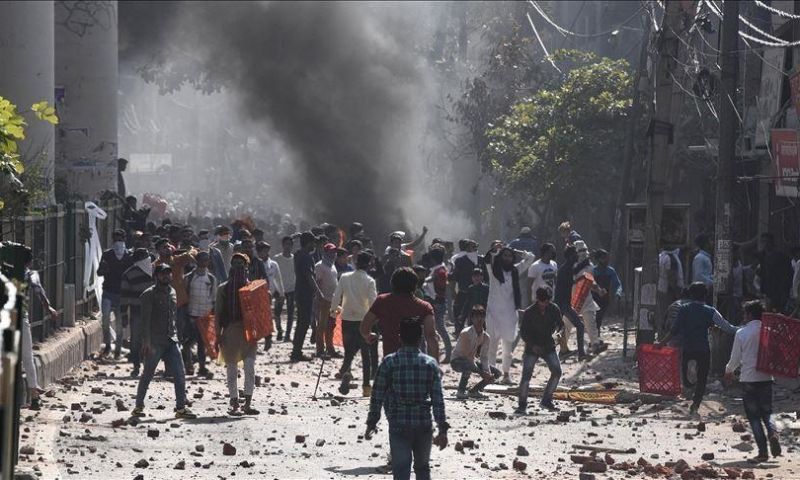
ISLAMABAD: Nearly six years after communal violence shook India’s capital, the legal fallout from the February 2020 Delhi riots has become a defining test of judicial independence, minority protections and the handling of dissent in the world’s largest democracy.
The violence erupted in northeast Delhi amid nationwide protests against the Citizenship Amendment Act and the proposed National Register of Citizens.
Fifty-three people were killed, and hundreds were injured, with Muslims accounting for the majority of fatalities.
The episode marked one of the most serious outbreaks of communal unrest in New Delhi in decades.
Since then, the focus has shifted from street violence to a complex and protracted courtroom battle.
Several activists and student leaders were charged under the Unlawful Activities (Prevention) Act (UAPA).
They were booked under India’s principal anti-terror legislation, in what authorities described as a coordinated conspiracy behind the riots.
The law’s bail provision requires courts to deny relief if accusations appear prima facie true, a standard critics argue significantly narrows the space for judicial discretion.
As of late 2025 and early 2026, multiple accused remain in custody with bail pleas pending.
The Supreme Court of India issued notices in September 2025 on several such petitions, with hearings scheduled the following month.
Repeated adjournments and procedural delays have heightened concerns about extended pre-trial detention sans substantive movement toward a full trial.
Among those charged are prominent student figures who had publicly opposed the citizenship legislation.
Some, including Umar Khalid, have spent more than five years in detention without the conclusion of trial proceedings.
Human rights organisations contend that prolonged incarceration in such circumstances risks turning the legal process itself into a form of punishment.
Prosecutors rely on extensive charge sheets, digital evidence and protected witness statements to support the conspiracy narrative.
Defence teams have challenged the interpretation of protest speeches as criminal incitement and questioned the credibility and disclosure of evidence presented by investigators.
The broader controversy centres on allegations of differential policing.
Critics argue that investigative emphasis in the principal conspiracy case has focused disproportionately on Muslim activists, despite the violence involving individuals from multiple communities.
Separate riot cases involving alleged Hindu participants have produced a mix of acquittals and pending trials, reinforcing claims of uneven enforcement.
International rights groups, including Amnesty International, have described aspects of the prosecutions as emblematic of shrinking civic space in India.
The Indian government rejects these assertions, maintaining that the cases are grounded in evidence and proceed under judicial supervision.
Legal analysts observe that the litigation now transcends criminal accountability. It has become a focal point in global debates on the balance between national security legislation.
The civil liberties, the presumption of innocence, and the institutional resilience of democratic courts in politically sensitive contexts are faced with a litmus test.
With the key accused still awaiting final adjudication and procedural delays continuing, the Delhi-2020 riots case remains a critical benchmark.
It is an objective assessment of minority rights, equal protection under law and the long-term credibility of India’s justice system.